

OLYMPIA—In a bombshell complaint that rips the veil off alleged media collusion and undisclosed political muscle, Ari Hoffman has accused The Seattle Times and a web of connected nonprofits of systematically failing to report the true value of what he calls undeclared political advertising and in-kind contributions worth at least $44,090.64—and potentially more than $100,000—against 2024 ballot Initiative 2117.

Hoffman’s 16-page complaint filed with the Washington State Public Disclosure Commission (PDC), paints a picture of the state’s leading and largest newspaper with an average daily print circulation of roughly 60,000 whose philanthropically bankrolled “Climate Lab” churned out coverage that amplified the exact messaging of the well-funded “No on 2117” campaign, while the paper’s own editorial board openly urged voters to reject the measure which may have contributed to the initiative’s failure with a 61.95% no vote.

Hoffman demands a full investigation into whether these communications crossed the line from journalism into reportable campaign activity under RCW 29B.25.090 and related campaign-finance laws.
The complaint names The Seattle Times Company, the Seattle Foundation, Clean & Prosperous Washington, Clean & Prosperous Institute, Green Jobs PAC, and the No on 2117 committee as respondents. It alleges they failed to disclose the commercial-equivalent value of articles, editorials, research assistance, data, mapping, media outreach, and distribution that opposed the initiative during the 2024 election cycle. At the center sits the Seattle Times Climate Lab—a team inside the newspaper’s newsroom that is primarily paid for by external donors, foundations, or philanthropic grants. The Climate Lab launched in February 2024 and according to the paper’s own then-Publisher and CEO Frank A. Blethen, produced coverage “not otherwise available” thanks to community investment.



According to the Seattle Times’ website: “Climate Lab is a Seattle Times initiative that explores the effects of climate change in the Pacific Northwest and beyond. The project illuminates the impacts of heat waves, drought, wildfire and flooding and examines government and industry actions, to help the public better understand how greenhouse gas emissions are changing our lives.”


Hoffman argues that Climate Lab was no ordinary newspaper beat as it is largely funded by foundations and donors—including the Bullitt Foundation, Becky and Michael Hughes, the University of Washington, the Walker Family Foundation, CO2 Foundation, Jim and Birte Falconer, the Henry M. Jackson Foundation, the Martin-Fabert Foundation, and Craig McKibben and Sarah Merner.

According to the PDC, a Sarah Merner contributed $500,000 to the No on 2117 on February 8, 2024, and a Craig McKibben contributed $500,000 to the No on 2117 also on February 2, 2024—both contributions were made the same month the Seattle Times launched Climate Lab.

The Seattle Times added four dedicated newsroom positions to write on content allegedly aligned with No on 2117 talking points and the Seattle Foundation served as Climate Lab’s fiscal sponsor.
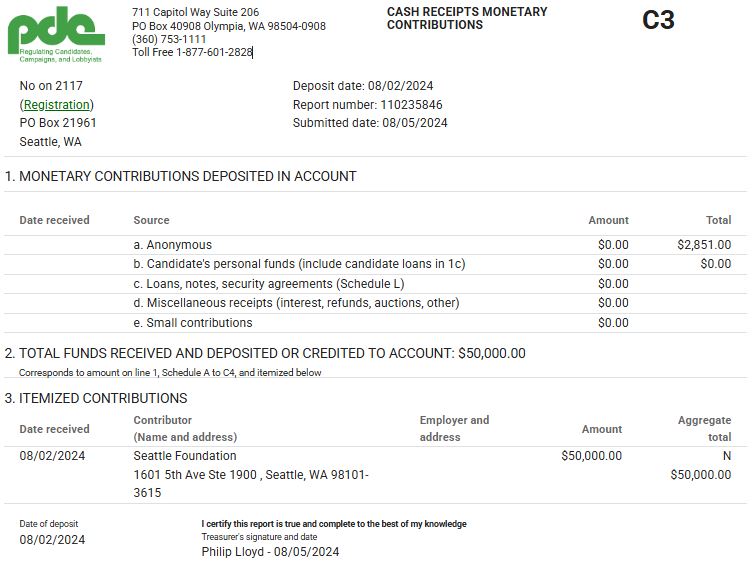
According to the PDC, on August 2, 2024, Seattle Foundation contributed $50,000 to No on 2117 PAC.
The same Seattle Foundation on June 25, 2024, published an explicit political communication titled “Protect the Climate Commitment Act: Vote No on I-2117,” authored by staffer Kendall Hill, complete with the required disclaimer “Paid for by: Seattle Foundation.” The foundation described the Climate Commitment Act as vital policy, warned of consequences from repeal, and announced it was joining the opposition campaign.
Hoffman is asking the PDC to determine whether fiscal-sponsorship services, staff time, or other resources overlapped with the advocacy or with Climate Lab’s election-season coverage.
Meanwhile, Clean & Prosperous Washington—a nonprofit that describes itself as advancing smart clean-energy solutions developed “Risk of Repeal,” a project that mapped more than 2,000 Climate Commitment Act-funded investments totaling roughly $2 billion. The group distributed newsletters and press releases that was republished by news organizations and the media and reported approximately $176,832 in CCA Mapping/Education expenditures.
Executive Director Michael Mann oversaw the effort. Clean & Prosperous later specifically flagged the Seattle Times Climate Lab’s October 18, 2024, article—“WA’s carbon market pumps billions of dollars to state projects. What happens if it vanishes?” by reporter Amanda Zhou—as an example of “Risk of Repeal amplification.”
According to the IRS 990 filings, Mann is listed at the principal officer of Washington Business Alliance which received $75,000 from Clean and Prosperous America where Mann is also listed as the principal officer. Mann reported a total compensation of $214,851 from both non-profits.
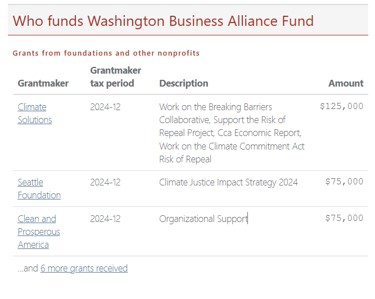
The Washington Business Alliance also received $75,000 from the Seattle Foundation that funded the Seattle Times’ Climate Lab and $125,000 from Climate Solutions for “Work on the Breaking Barriers Collaborative, Support the Risk of Repeal Project, Cca Economic Report, Work on the Climate Commitment Act Risk of Repeal.”
According to Washington Business Alliance IRS 2024 filing, it expensed $12,404,371 towards grants to 501(c)(3) organizations that “focused on either educating individuals about climate change or educating individuals about how to register and vote. Washington Business Alliance fund also produced and published online educational information about climate change and potential ways to address it. Additionally, WBAF hosted a climate study event and a carbon policy forum to provide further education around climate change policy.”

The complaint lists eight specific Seattle Times communications from March through October 2024 that Hoffman classifies as having direct “election nexus”: five Climate Lab pieces including Amanda Zhou’s high-priority October story just 18 days before Election Day titled, “WA’s carbon market pumps billions of dollars to state projects. What happens if it vanishes?”, and earlier work by Isabella Breda and Conrad Swanson plus three Editorial Board items, one of which carried the headline “The Seattle Times editorial board recommends: Keep WA’s Climate Commitment Act – vote no on I-2117.” Editorial Page Editor Kate Riley and board members Melissa Davis, Josh Farley, Alex Fryer, Claudia Rowe, and Carlton Winfrey are named among potential witnesses, as are Seattle Times Board member Frank Blethen, reporter Amanda Zhou, reporter Isabella Breda, reporter Conrad Swanson, Seattle Foundation staff member Kendall Hill, and Clean & Prosperous Executive Director Michael Mann.
The complaint argues that the public “has a significant interest in knowing whether any of that outside financial support, research, services or other assistance was connected to communications concerning Initiative 2117 and, if so, whether resulting contributions, expenditures or political advertising were properly disclosed.”
It further alleges that The Seattle Times also commercially sells native and branded content in article form, content “made to influence statewide ballot propositions.”

Using The Seattle Times’ own 2024 commercial advertising packages—a full-page ad plus 200,000 digital impressions plus a branded-content article priced at approximately $5,511.33—Hoffman estimates a minimum integrated commercial-equivalent value of 8 × $5,511.33 or $44,090.64 with a potential full value exceeding $100,000 when other promotional media is assessed.
An article-production-only floor using incremental branded-content charges of $1,500–$1,750 yields $12,000–$14,000. He stresses this is the floor; it excludes homepage takeovers, newsletter placements, social media (Facebook, X/Twitter, Instagram), push notifications, photography, graphics, video, paid boosts, third-party research, and any portion of the $176,832 mapping spend that may have flowed into the coverage.
The complaint does not claim every Climate Lab story was pure propaganda; however it does argue that the combination of outside philanthropic funding that explicitly enabled the coverage, a fiscal sponsor that itself engaged in express advocacy, an advocacy group that trained media and then claimed the resulting stories as its own amplification, and the Seattle Times own commercial advertising rates creates a compelling case for scrutiny.
Washington voters, Hoffman writes, are entitled to know the source and value of political advertising and in-kind contributions that influence statewide ballot measures. The Seattle Times sells advertisers access through the same channels—articles, homepage placement, newsletters, social media—that carried the contested content. When those channels are used for election-related messaging underwritten or assisted by campaign-aligned interests, disclosure rules may apply, he said.
“Washington’s campaign-finance laws must be applied consistently,” Hoffman released in a statement. “The Seattle Times has every right to editorialize against an initiative. The question is whether outside organizations involved in defeating I-2117 provided money, research, data, services or other things of value used to produce or distribute election-related communications without required disclosure.
“If the PDC is going to investigate independent media figures and content creators for alleged undisclosed in-kind political advertising, then it should investigate legacy media under the same standard. Washington cannot have one set of campaign-finance rules for independent media and another for The Seattle Times.”
The PDC now will determine if the complaint is warranted, and if deemed so, will open a formal investigation on the matter.
The Lynnwood Times did reach out to Ryan Blethen, publisher of The Seattle Times, for comment on Hoffman’s complaint.
Initiative 2117 and the Cap-and-Invest Repeal
Initiative 2117 sought to prohibit state agencies from imposing any type of carbon tax credit trading, also known as “cap-and-invest,” and repeal provisions of the Washington Climate Commitment Act passed by the legislature on April 24, 2021, and signed into law by Governor Jay Inslee on May 17 of that same year. The CCA places a declining limit on greenhouse-gas emissions from the state’s largest polluters, requires them to buy allowances, and channels the proceeds—approximately $5 billion as of June 2026—into climate, clean-energy, transportation, tribal, and community projects.
The initiative was sponsored by Let’s Go Washington, a committee founded by Redmond hedge-fund manager Brian Heywood.
Those in favor of I-2117 called Washington’s carbon tax a “hidden tax that hurts low-income people,” resulting in state gas prices skyrocketing— nearly 40 cents per gallon. They further argue that the tax kills small businesses and good jobs while giving “billions to government bureaucrats with little left for tackling pollution and climate change.”
In the opposing side, over 500 organizations and Tribes opposed I-2117 and endorsed the No on 2117 campaign, including firefighters, small businesses, Tribal Nations, doctors, nurses, and public health leaders (even Bill Nye the Science Guy), labor unions, and environmental groups.
The No on 2117 committee raised and spent roughly $16.7 million, according to PDC filings. Approximately $8.7 million poured into broadcast/cable TV advertising with $1.8 million in digital ads, and $1.5 million in contributions to allied groups/PACs.
Green Jobs PAC, closely tied to the opposition effort of I-2117 and mentioned in the Hoffman complaint, raised and spent about $3.2 million. Clean and Prosperous reported that more than $3 million was raised through Green Jobs PAC specifically for paid media. The Washington Public Disclosure Commission in June 2025 imposed a $20,000 penalty to settle a case against Green Jobs PAC for “late reporting of more than $1 million in expenditures in the 2024 election cycle.”
Let’s Go Washington’s, I-2117’s sponsor, raised and spent roughly $10.2 million of which Heywood personally contributed $750,000.
Voters in November 2024 overwhelmingly rejected I-2117 with approximately 62% voted no, preserving the CCA.
Washington state on June 25 signed a historic carbon market linkage agreement with California and Québec, setting the stage for large-scale greenhouse gas reductions and long-term investment in clean energy across the jurisdictions.

Author: Mario Lotmore