


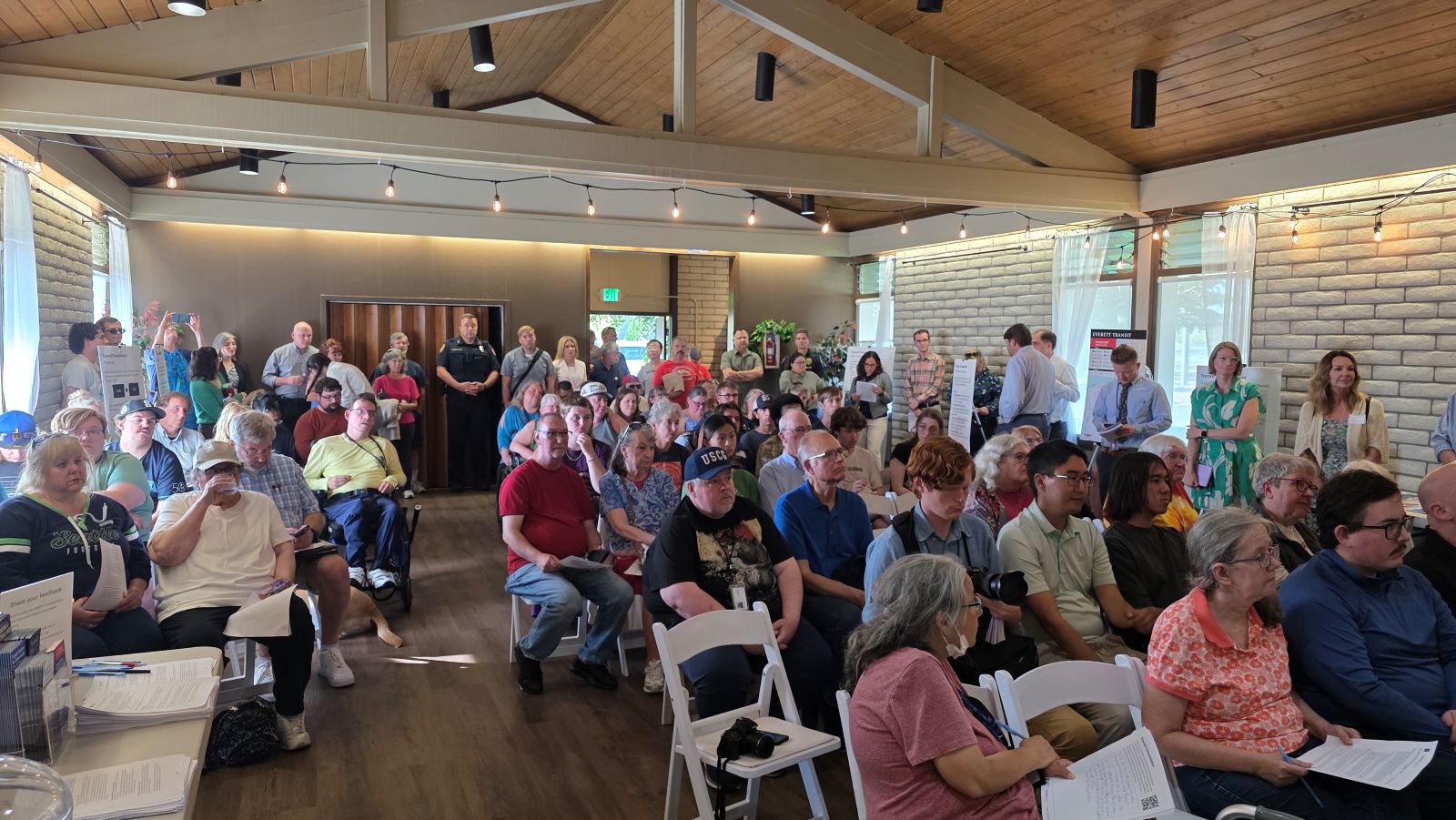
EVERETT—Mayor Cassie Franklin shared with roughly 100 residents on Tuesday who packed the Banquet Room of the Walter Hall Golf Course for a public open house to learn more about the process and potential impacts on the potential acquisition of Everett Transit by Community Transit, that there will be “absolutely no reduction in paratransit service.”
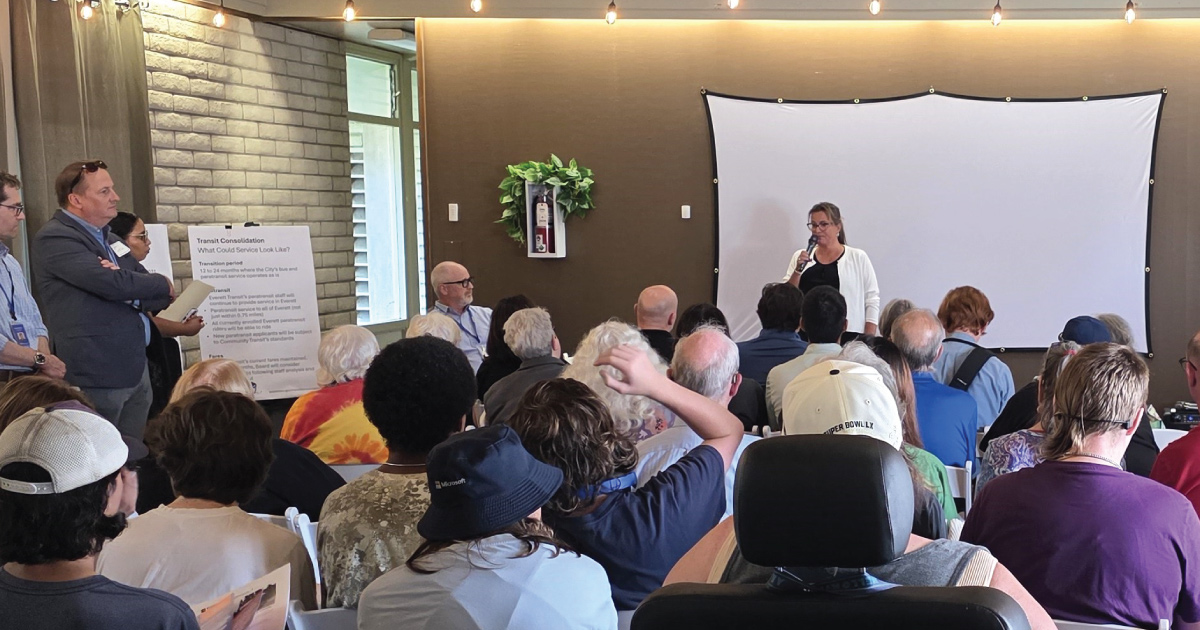
“That was kind of a line in the sand,” Mayor Franklin said. “And asked Community Transit to preserve and protect paratransit as is, and we have gotten that commitment from Community Transit that every passenger that is currently using paratransit in Everett will continue to be able to use paratransit in Everett. Every driver that drives paratransit in Everett will continue to provide paratransit services. So, there is absolutely no reduction in paratransit service in the city of Everett in a consolidated plan, which was very important to me and this community.”
Since the announcement of the resumption of joint efforts to consolidate Everett Transit and Community Transit into a single, expanded network serving Everett and Snohomish County, on April 22, a key area of contention between the Everett Transit Local ATU 833 Union has been paratransit as Community Transit currently outsources this service to France-based Transdev.
Union President Steve Oss is wary of Community Transit’s commitment post-merger that paratransit users are going to keep service.



“Well, it’s not going to be the same for the City of Everett because it’s [paratransit service] only for those who are in it now,” Oss told the Lynnwood Times at the open house. “For those who would have qualified the day after the merger, they won’t qualify, and they won’t get that service. If they’re 65, they qualify for us [Everett Transit]. For DART, they don’t. If they live more than three-quarters of a mile from a transit line, they qualify for us. For DART, they don’t. We are losing, and they’re keeping that part down.”


Oss also asserts that Everett residents should have the right to vote on a proposed 0.6% sales-tax increase if the merger were approved by councilmanic vote. He blames Senator Marko Liias (D-Edmonds), current Senate Transportation Committee chair, for sneaking (his word) into SB-5801, a method (via an interlocal agreement) for public transit annexations/consolidations without needing a public vote.
“The citizens should have the right to vote on a sales tax increase of 0.6 tenths of a percent,” Oss said. “The citizens absolutely should have that right. They’ve had the right in the past. Marko Liias down in Olympia in the Transportation Committee, he put in a clause that got kind of snuck through that allowed the vote to belong to the city council and we’re hoping that the city council, which I understand is a difficult thing, to turn down a power.”
The annexation would raise the overall sales tax rate in Everett from 9.90% to 10.50%—a 0.6-point increase—and generate at least an additional $29 million annually for transit starting in 2027, if enacted by then, according to City of Everett figures. The 0.6-point tax increase would generate an estimated $158.3 million in new revenue from 2027 through 2031 towards transit, something Mayor Franklin stressed as a need for Evertt’s projected growth.
“The city of Everett is growing we are growing kind of exponentially. If you look around, there’s a lot of cranes in the city. We finished our comp plan, which means we’re gonna, and plan for growth of about 65,000 new residents in the next less than 20 years. We’re also annexing about 35,000 to 40,000 or more residents into the city early next year,” Franklin told attendees. “So, this city is growing, and we are the urban center of Snohomish County. We’re the largest city north of Seattle. I know that we need robust transit options as we grow I certainly don’t want to add 65,000 parking spots and expand lanes of travel to deal with that congestion we need to move people out of their cars into public transportation options so that’s why we’re doing this that’s why it’s so important.”
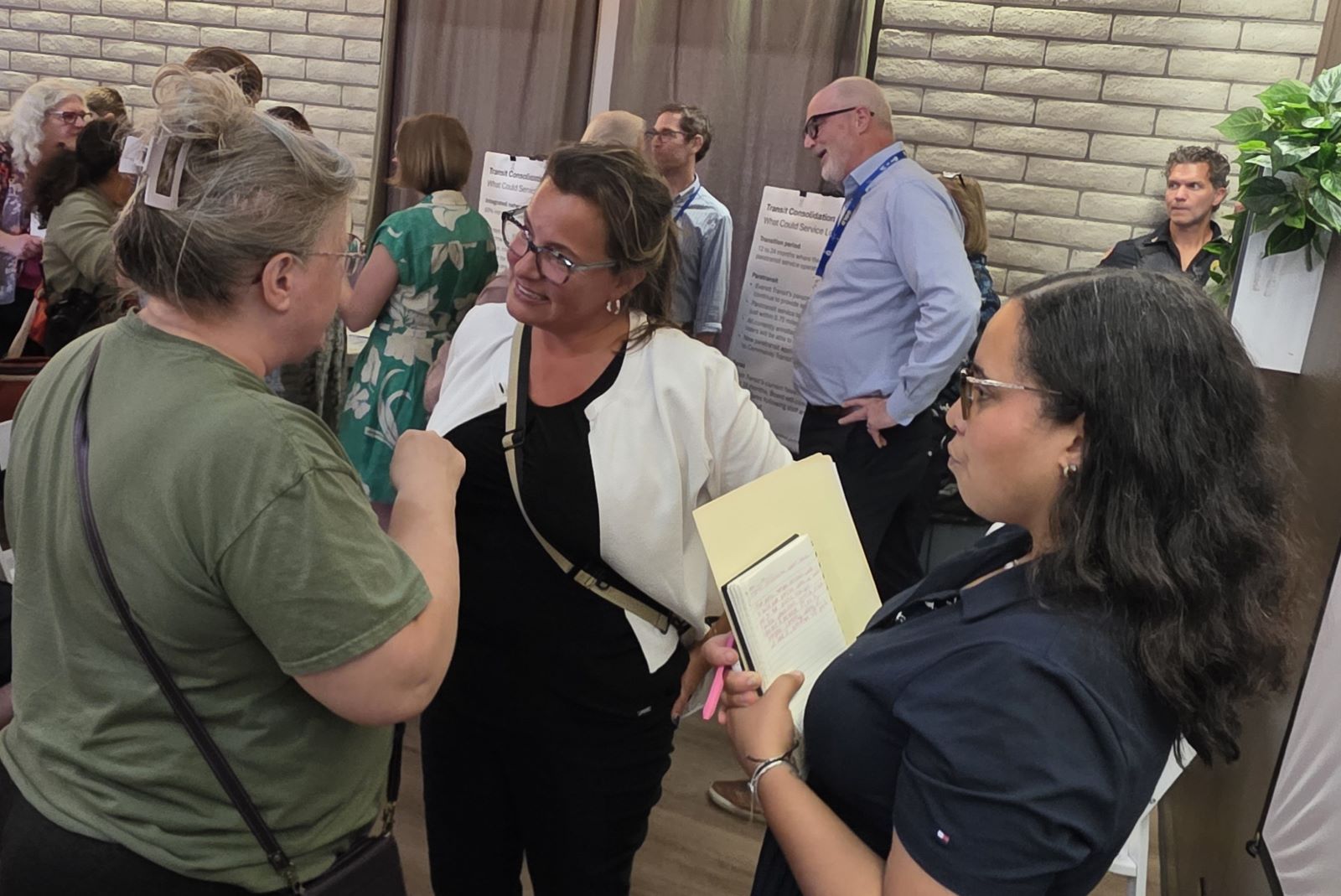
Mayor Franklin added that the consolidation is built on years of intermittent discussions aimed at addressing growth while preparing for the almost $8 billion in light rail stations in Everett over the next 15 years — a feat she co-championed with Snohomish County Executive Dave Somers.
“Additionally, we’re all really excited for light rail to get here…but we are finally in the planning phases for light rail and we’re going to have multiple Everett stations. And as we saw in Lynnwood, it is getting all kinds of passengers to those light rail stations via bus. There’s this complicated ballet of buses that bring people to and from those stations and we want to see that same service here in Everett. So that’s why I’ve been passionately looking at this,” she said.
She shared that her “first and foremost, in any consolidated system, taking care of our team members. It’s a priority for the city, and it’s a priority for community transit, and it’s the law.”
Mike Cornelius, International Vice President of the Amalgamated Transit Union (ATU), shared with the Lynnwood Times that he had a very productive multi-hour meeting between Community Transit and City of Everett representatives on the potential merger earlier Tuesday. He is representing both local 1576 (Community Transit represented workers) and Local 883 (Everett Transit represented employees).
Cornelius is involved to review and protect the Section 13(c) agreement of its union members under the Urban Mass Transit Act of 1964. That agreement is required for recipients of federal operating assistance/grants. The federal statute spells out that the protective arrangements must include (at minimum) the following elements:
- Preservation of rights, privileges, and benefits (including pension rights and benefits) under existing collective bargaining agreements or otherwise.
- Continuation of collective bargaining rights.
- Protection of individual employees against a worsening of their position with respect to employment (this is the broadest protection and can include up to six years of full pay and benefits in some displacement cases).
- Assurances of employment to employees of acquired transit systems, plus priority of reemployment for employees who are terminated or laid off.
- Paid training or retraining programs.
Because both transit agencies receive substantial Federal Transit Administration grant monies — Community Transit has received at least $293 million since 2020 and its adopted 2026–2027 budget projects a need of $63.5 millions in the latest adopted budget in FTA formula grants, while Everett Transit has received $20 million to $30 million — Section 13(c) protections will govern the annexation. The protections cover ATU Local 883 and Community Transit’s ATU 1576 union members. Non-union administrative staff receive fewer automatic safeguards but fall under the “fair and equitable” standard. The law also prevents transit agencies from using a merger as a guise to undermine contracts or collective bargaining units. The FTA will not approve mergers not aligned to the law and contested by impacted labor unions.
Cornelius shared with the Lynnwood Times that City of Everett paratransit workers are public employees with pensions and because Community Transit contracts that work to Transdev, a private company with no pension, removing Everett Transit paratransit drivers would worsen conditions and violate 13(c). He is also working to protect their healthcare coverage.
“We sat down, we had a really good dialogue,” Conelius told the Lynnwood Times on how his meeting with Community Transit and City management went. “It was a several hour dialogue. It’s not gonna be resolved today, obviously because the Everett City Council still has to vote, the Community Transit authority board still has to vote. We’re not sure that it’s a guaranteed vote that the merger’s gonna happen. The locals are very concerned about the impact on taxes and a vote of a council or some board deciding a public tax issue when they believe that should be a right of the voter. So, there’s a lot of things at play here. So, pension is at play, health care is at play, right of the voter to vote on taxation is at play, and also preservation of collective bargaining rights for the workers.”
Once an interlocal agreement is drafted, the agencies must notify the union of intended changes Cornelius shared. The union then has 30 days to trigger Section 13(c) negotiations and any unresolved issues can go to arbitration, and federal assistance can be withheld until the International ATU accepts the arrangement.
The Everett City Council and Community Transit Board are expected to consider the interlocal transit agreement in mid-September. A public hearing on the consolidation is planned for mid-October, followed by action and a vote on annexation and consolidation by both bodies in late October, Jason Kelly, Communications Director of the City of Everett, told the Lynnwood Times.
Councilman Ben Zarlingo in the interview at the open house did not state how he would vote but described the factors he and possibly the council will weigh.
“Well, probably taxes will be one of the biggest ones,” Zarlingo told the Lynnwood Times. “The level of service, what sort of efficiencies we get, essentially what do we pay, what do we get, how does it serve the different communities.”
Community Transit CEO Ric Ilgenfritz addressed future plans for service in his statements to attendees on Tuesday.
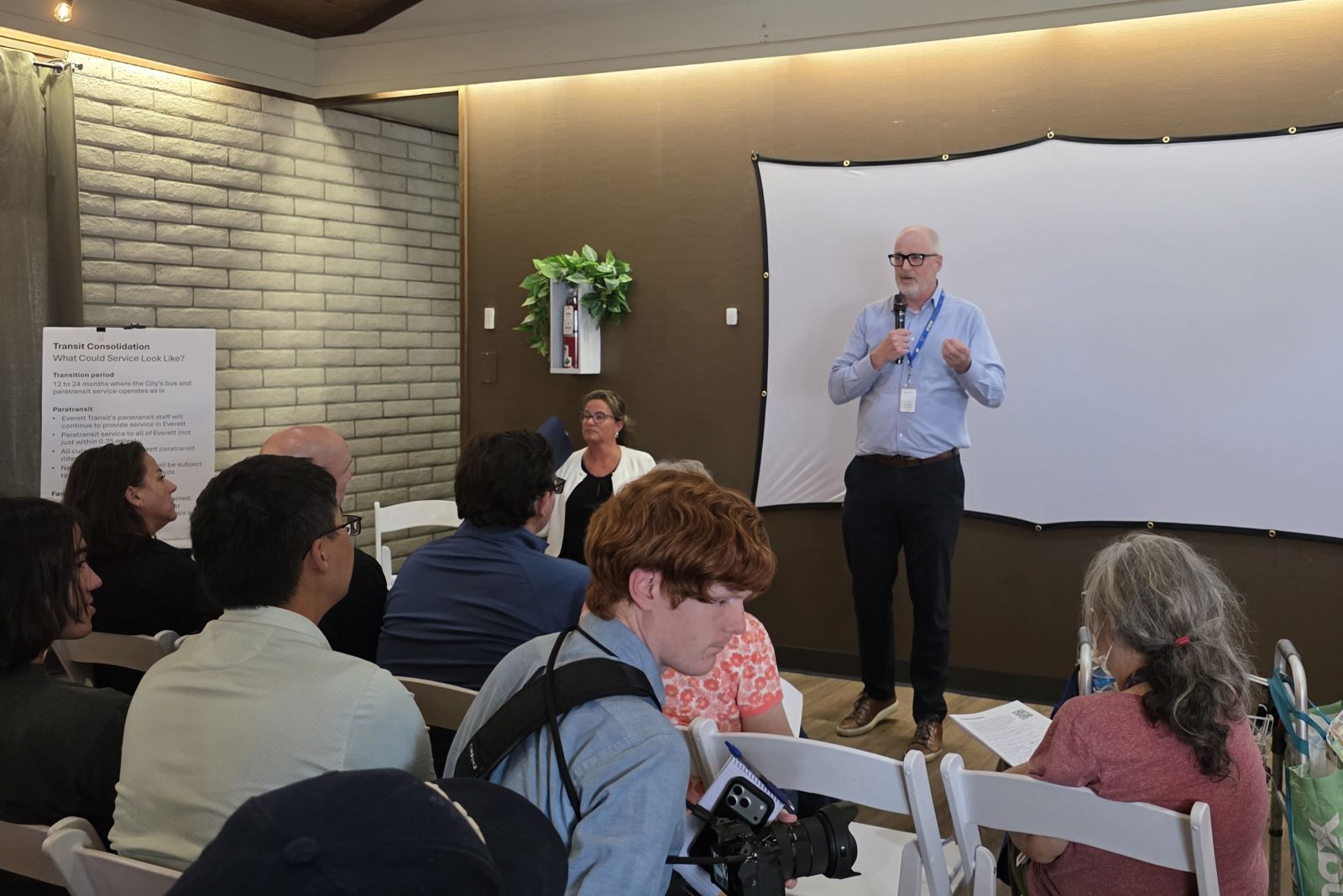
“This conversation is how to make that experience for both employees and customers even better, to make more possibilities available to all of you as part of a growing network and a growing county and a thriving economy here in this part of the region,” Ilgenfritz said.
He explained that both transit agencies have operated side by side for more than 50 years but now face inefficiencies from separate networks that “collide with each other in certain places” and lack optimal frequency or all-day service.
“The opportunity we have is to join forces and leverage each other’s strength and each other’s resources to build something that’s bigger and better and more in service of the community than exists today,” he said. “If we do our jobs right, those of you who are delivering the service today in Everett and those of you who are using the service today in Everett won’t see any difference. You’ll see things continue as they are today, and then as we get into 2027, you’ll see the service and the network take off. You’ll see new connections, new opportunities, more frequency, more reliability, more transit jobs, more opportunities to help grow the economy of Snohomish County and the city of Everett.”
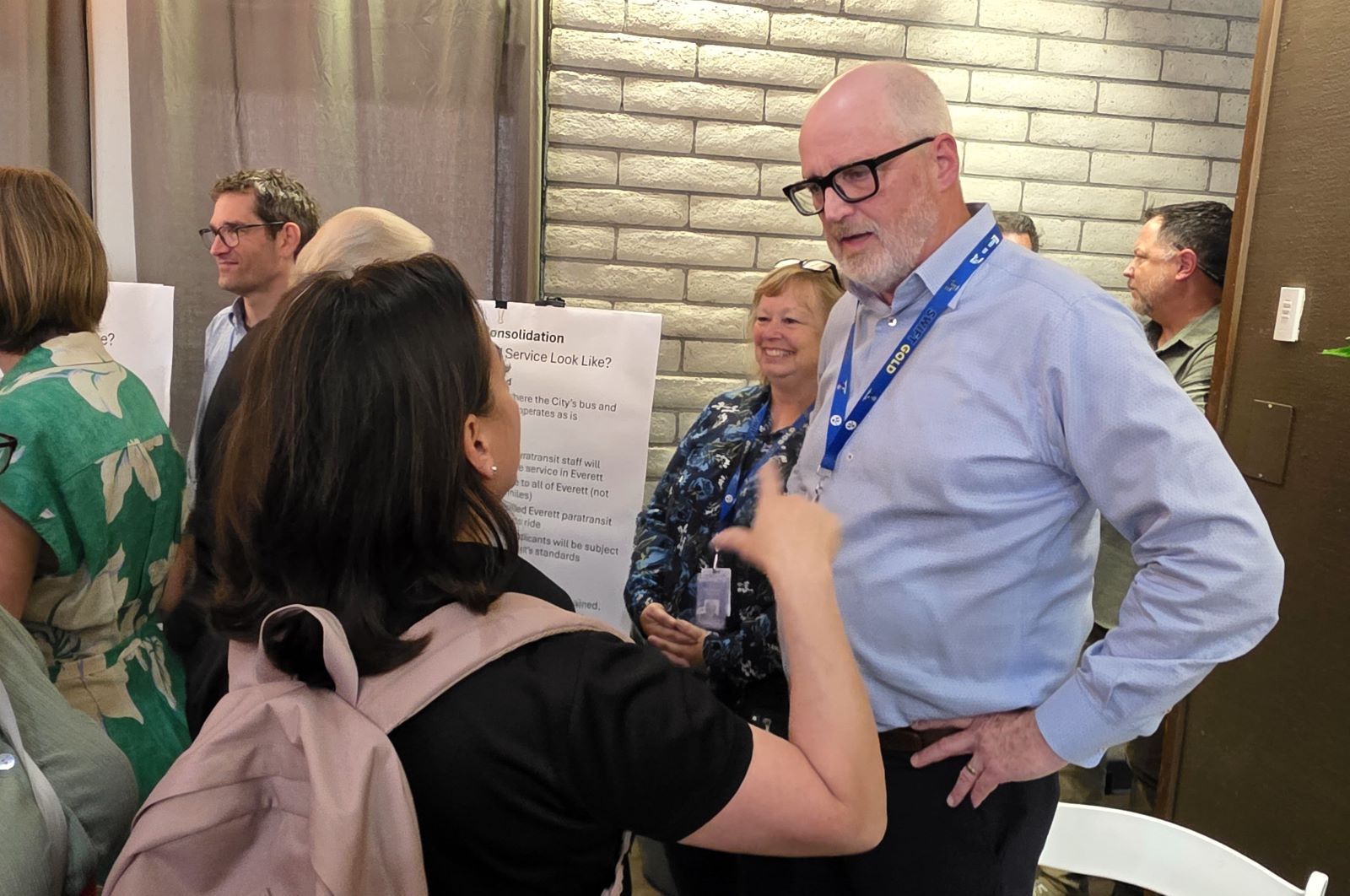
Ilgenfritz committed to a culture where employees remain empowered and passionate about their work.
“My commitment is to make sure that it happens as successfully as it possibly can,” Ilgenfritz said. “That every employee doing this work is enfranchised, is committed, is passionate and able to bring that passion and do their best work every single day. That everybody who wants to use the bus, whether it’s to get from point A to point B or home to work or home to school or to the train or downtown or to the airport, that you have that opportunity and you don’t have to hesitate about it because it’s always there.”
Laura, a resident in the South Everett / 128th corridor who uses paratransit services told the Lynnwood Times she strongly supports the merger. She hopes a consolidated transit agency would allow one phone number, cross-agency drop-offs, and easier travel—especially near the airport/Boeing and for people with disabilities.
“It needs to happen, the merger. It needs to happen,” she said.
Elizabeth, Vice President of ATU Local 883, opposes the merger. She is against the sales tax increase of 0.6% if the merger were to go through and is doubtful of Community Transit’s promise to keep paratransit “like it is.”
“The promise to keep paratransit like it is, is only through 2027,” Elizabeth told the Lynnwood Times, “After that, our contract is up and it will all be negotiated after that. Our concern is mostly for the citizens. They have voted against this since 1976 and their right to vote on this has been taken away from them. And I don’t think the residents realize that yet.”
Jaswinder Baines, President of ATU Local 1576 which represents Community Transit employees, shared that he is supportive of ATU Local 883 at this stage and added that he has no comment on the merger until a vote occurs.
“We’re here to support ATU 883 right now… we want to make sure we are there for our members if they do go through. But right now, we’re just here to support 883,” Baines said.
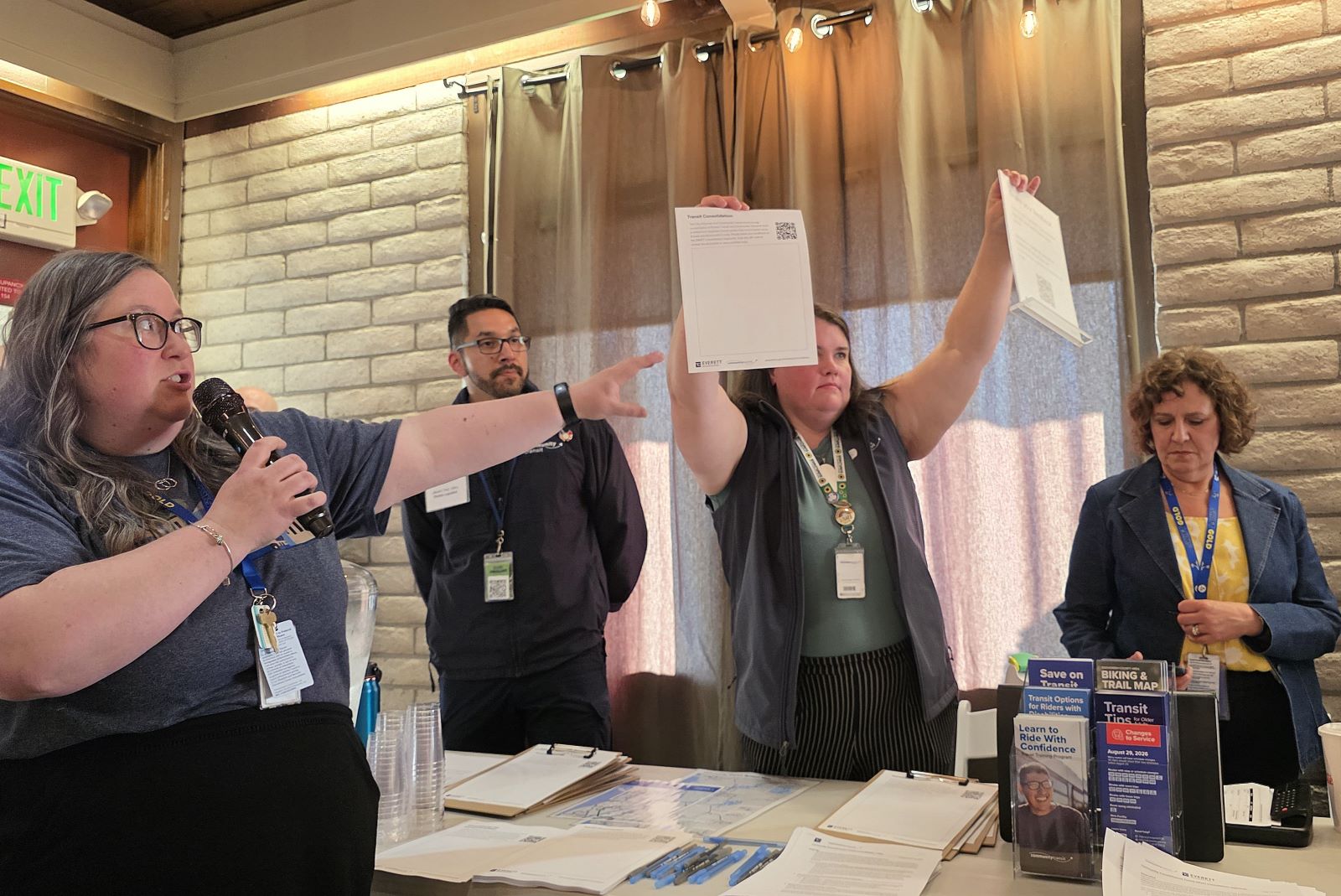
If the merger were approved by all parties, another round of community engagement on the integrated plan network is set for 2027, with phased implementation of service improvements from March 2028 to 2031.
Community members who did not attend the in-person open house can still provide feedback until September:
- Complete the online form: bit.ly/etctsurvey
- Send an email: communications@everettwa.gov
- Send a letter to: City of Everett Communications, 2930 Wetmore Ave., Suite 10-A, Everett, WA 98201
- Leave a voicemail: 425-257-7121
To learn more on the merger, visit the City of Everett’s webpage at everettwa.gov/transitconsolidation.

Author: Mario Lotmore



One Response
Everett loves to follow in Seattle’s footsteps.. time to recall the Everett mayor!