
SEATTLE—The Sound Transit Board of Directors adopted a $57.5 billion updated Sound Transit 3 system plan late Thursday night, rescuing the ambitious 2016 voter-approved light rail project from a $34.5 billion shortfall and setting a clear, affordable path forward to providing a truly integrated regional transit system connecting Everett to Tacoma.
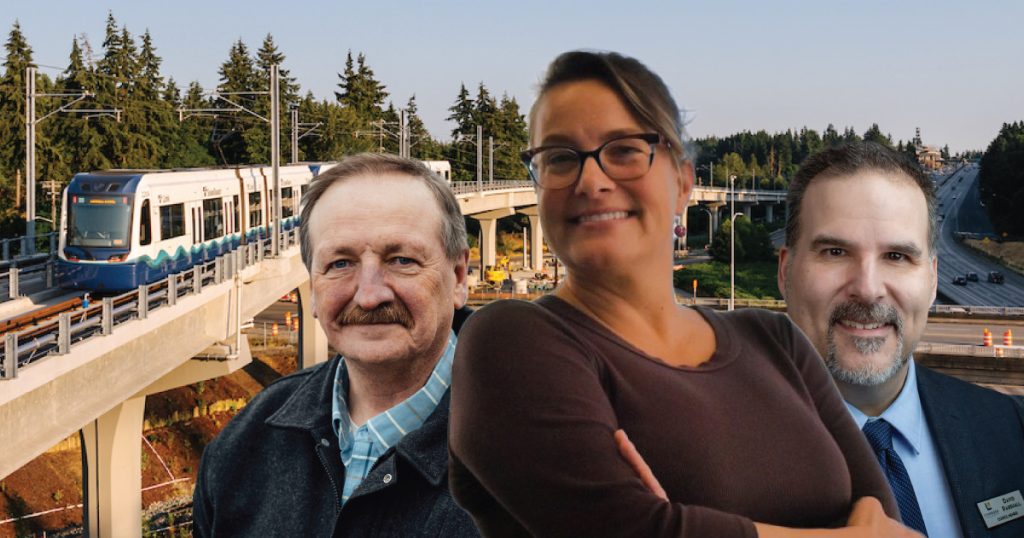
“This resolution reflects both realism and optimism — addressing today’s financial pressures while preserving our long-term commitment to delivering the regional transit system voters approved,” said Sound Transit Board Chair and Snohomish County Executive Dave Somers. “While the financial challenges facing Sound Transit are significant, this action creates a responsible path forward that keeps critical projects moving, protects the long-term health of the system, and positions us to advance more of the ST3 vision as economic conditions improve and new opportunities emerge.”


“We heard clearly from residents across Pierce, King, and Snohomish counties that transit matters deeply to the future of this region. People care about timelines, equity, affordability, and accountability — and they should. Those voices helped shape this updated plan and will continue to guide this Board moving forward. This region has repeatedly demonstrated a willingness to invest in its future,” Somers added.
Thursday’s vote was a cumulation of two additional board retreats, dedicated discussions at nearly every meeting, more than 20 community meetings, and over 17,000 survey responses, Sound Transit CEO Dow Constantine shared.




“Over the course of the past year, the Board and agency staff have devoted significant time and attention to developing an updated, affordable system plan. Today marks the successful culmination of that effort,” said Constantine. “The level of engagement during this process demonstrates the passionate support for transit throughout the region. Following the Board’s action today, the direction to the agency is clear: Deliver more of the frequent, reliable transit people have come to rely on, and do it as quickly and as efficiently as possible.”


Everett Mayor Cassie Franklin delivered one of the strongest equity messages of the entire meeting sharing the benefits Sound Transit will bring to underserved communities in Snohomish County.
“When Everett Link opens in South Everett in 2037, it will serve a community who earns $67,000 per household most of those households are doubled and tripled up, who are 64% renters and 49% BIPOC,” Mayor Franklin said. “One third of these families speak a language other than English at home. So, this is really an important part of the system that we’ll be delivering on. And I really appreciate the entire board’s support of delivering on the spine. We’ve seen the positive transformational changes that light rail has brought to the communities. So, delivering on this proposal is about that; it’s about shared prosperity across the entire region.”
Lynnwood Councilmember David Parshall, representing Snohomish County on the Sound Transit Board, praised the plan’s strong focus on true regional connectivity.
“Sound Transit has dipped its toe into Snohomish County and Mountlake Terrace and Lynnwood, but mostly the system has been a King County system until now,” Parshall told the Lynnwood Times. “And that commitment going forward is getting farther into Snohomish County, it’s getting down into Pierce County, down to the Tacoma Dome. We’re making a commitment to the east side and making sure we get out to Issaquah…. We want to get Ballard done, but it was, I think it was a priority for all these outlying areas to feel like they’re a part of this whole system. And the only way to do that was focus on the spine and focus on going to areas that we haven’t been to yet.”
The total estimated remaining project cost to complete ST3 was projected at $149 billion by 2046 with a $34.5 billion cost avoidance need (up 25% since Fall 2024) no later than 2033 —approximately $30 billion of the cost overrun is attributed to capital cost growth. The West Seattle Link Extension ballooned from $4.2 billion in the finance plan to between $7 billion and $7.9 billion. The Ballard Link Extension climbed from roughly $11.9 billion to between $20.1 billion and $22.6 billion. Combined, the two lines exceeded $30 billion before adjustments—87% of the overall project cost overruns.
The 16-mile Everett Link Extension (Phases 1 & 2), expected to open between 2037 and 2041, has a 2026 estimated completion cost of $9.5 billion, up from $7.7 billion in 2025 or $2.9 billion since its 2021 based estimate, which is far less than the $30 billion for the West Seattle and Ballard extensions.
“This investment to Everett,” Jason Kelly, Communications Director for the City of Everett told the Lynnwood Times, “Will mean generational change in the station areas…New housing and jobs will spring up very quickly….These stations will result in new housing that gives families an opportunity to live near regional transit connections. And employers will seek out expansion sites near stations.”
In a 16-2 vote on Resolution R2026-11, board members greenlit construction-ready projects, advanced design and planning on others, and created flexible new tools to close remaining gaps through innovation, cost savings, and partnerships. The plan prioritized completing the regional spine from Tacoma to Downtown Everett, advances light rail in every subarea, and commits hundreds of millions more in planning dollars to prepare for the high-ridership extension of the Ballard link.
The board also approved Resolution R2026-12 adding 1.372 percent to the rental car tax, expected to generate $300 million, with 70 percent benefiting South King County.
Enterprise Planning Deputy Executive Director Alex Krieg shared the legal necessity to approve the ST3 system plan update. He stated that because every ST3 subarea now exceeds the 5 percent affordability threshold written into voter-approved policies there is now a freeze on spending until a balanced plan exists.
“When we face affordability challenges at the scale of those we are dealing with now, there are legal limits to how the agency can spend money, especially for higher cost phases like final design and right of way, as in the West Seattle project,” Krieg told Board members. “Getting back to a balanced and affordable plan is the method by which those legal limits are resolved and enable the agency to confidently move forward with project delivery.”
The Sound Transit District is made up of five subareas, each with dedicated funding mechanisms: Snohomish, North King, South King, Bellevue, and Pierce. Voters in the North King and South King subareas could put “forward a sort of ‘ST-4 light’ for their area to finish off any extension of the project.
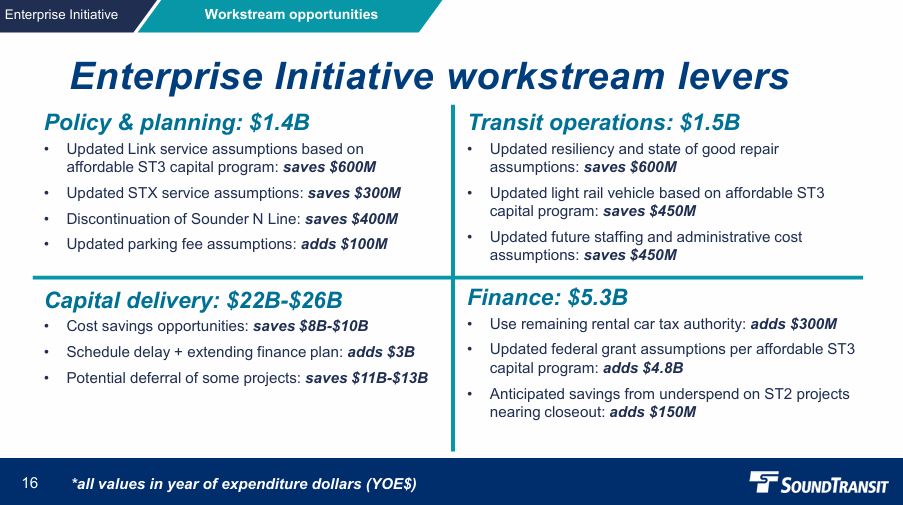
To get ST3 back on an affordability track, Krieg outlined a plan with $1.4 billion in policy and planning savings, $1.5 billion from operations adjustments, $5.3 billion from finance levers including stronger federal grant assumptions, and $22 billion to $26 billion in capital delivery efficiencies. He stressed that “no project in the ST3 program is canceled or eliminated.”
Chair Somers called Thursday’s approval of the resolution a hard-won starting point after more than a year of intense work.
“This is the kickoff to actually delivering the Sound Transit 3 plan,” Somers said.
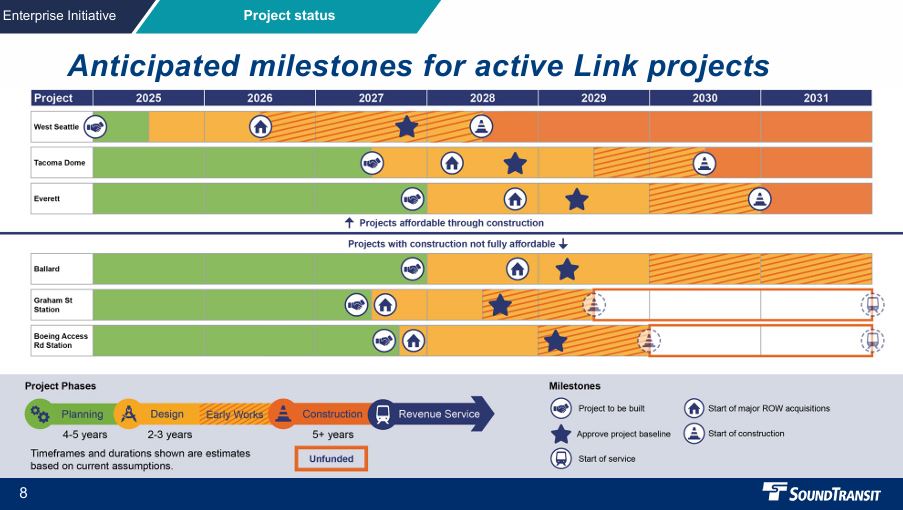
Under the newly approved plan, fully funded projects ready for construction include the Tacoma Dome Access Improvements, West Seattle Link Extension without the Avalon Station, Renton Transit Center Parking Garage, Tacoma Dome Link Extension, Everett Link Extension Phases 1 and 2, Ballard Link initial segment to Seattle Center, the delayed T Line to Tacoma Community College now targeted for 2043, South Kirkland to Issaquah Link now pushed to 2050, two new Link operations and maintenance facilities, the Graham Street infill station, and the Sounder Maintenance Base.
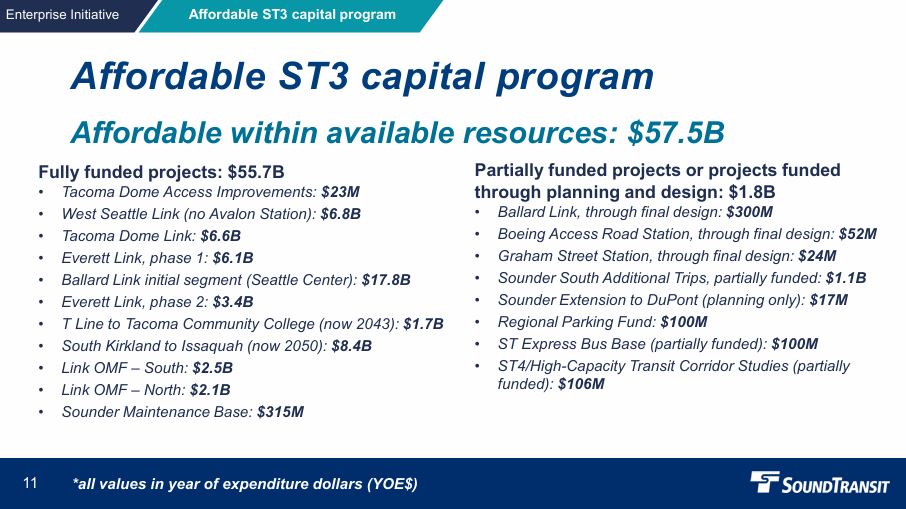
Partially funded efforts that will advance through planning and design — preserving momentum and options for future construction — encompass the remainder of the Ballard Link Extension, Boeing Access Road infill station, additional Sounder South trips, the DuPont Sounder Extension planning, a new Regional Parking Fund, remaining ST Express bus base work, and high-capacity transit corridor studies that lay groundwork for future expansions.
Projects not currently affordable within existing resources but still prioritized for aggressive pursuit of new funding include the Ballard Link segment from Seattle Center to Market Street, the Boeing Access Road infill station, additional Sounder train trips, DuPont Sounder Extension final design and construction, and further corridor studies including ST4 planning.
Deferred until new financial capacity materialize are several parking facilities—Tacoma Dome ($217 million), Everett Transit Center ($285 million), Stride BRT ($521 million), Edmonds and Mukilteo near Sounder stations ($87 million)—the North Sammamish Park-and-Ride ($60 million), specific bus-on-shoulder and corridor improvements ($300 million), and South Sounder platform and access enhancements ($734 million).
Sound Transit 3 Updated Plan Amendments: Heated Debate
The most contentious item of discussion came near the end of the near six -hour meeting with Amendment 13, proposed by Seattle Councilmember Dan Strauss who aggressively sought to redirect North King County’s share of Ballard Link funding to prioritize construction all the way from Westlake through Dravus Station in Ballard rather than stopping at Seattle Center—at least a $9 billion cost overrun.
Strauss argued the currently funded segment—SODO to Seattle Center—is “redundant” because it already has the downtown tunnel and monorail, while the real gap is the part that connects new riders in dense underserved neighborhoods.
“I have the last bus that goes to Ballard left a half an hour ago now,” Strauss said as evening wore on. “Seattle Center is nowhere near Ballard. The station at Dravus serves directly isolated neighborhoods. The station in Ballard serves the entire region.”
Supporters, including Seattle Mayor Katie Wilson and King Councilwoman Teresa Mosqueda, viewed it as a concrete step toward actual Ballard service.
Opponents saw the amendment as an existential risk to the entire ST3 project itself.
“This amendment, if passed, would grave risk the entire ST3 package — West Seattle, Ballard, Everett, Tacoma, Eastside, et cetera,” Chair Somers firmly warned. “It is a major change to the project alignment and operation. Environmental process for every project will stop and have to be reassessed.”
Everett Mayor Franklin, who shared she lived in Ballard for years and that her daughter was born there, moved to table the amendment.
“It puts the entire system at risk,” she said. “We cannot risk the entirety of the system for this exploration.”
Tukwila Mayor Thomas McLeod and Pirce County Executive Ryan Mello agreed that the potential delays to the spine and additional environmental reviews across the program were unacceptable.
The motion to table failed 4-14, however Amendment 13 itself went down in flames 4-14, with yes votes from Mosqueda, Renton Councilmember Ed Prince, Strauss, and Wilson.
“This particular vote doesn’t end Ballard,” Lynnwood Councilman David Parshall said. “That’s a really important point to reemphasize here today. And I think one thing that Board Member Strauss has continued to expound upon is there is dedication from all of us to get to Ballard, even if we don’t have a way to pass this particular vote today.”
Immediately before intense debate on Amendment 13, Strauss forced early transparency on Ballard timelines with his proposed Amendment 12 which passed 13-5, requiring staff by August 1, 2026, to provide the public a fixed date or range for when Ballard Link Extension service will begin. Strauss argued that repeated project delays have eroded public trust and created a vacuum filled by “speculation” and “memes.”
“Any date past 2041 is bad and we should know where we are today,” Strauss said. “Do we have a bad headline today? Or do we have a bad headline tomorrow?”
Enterprise Planning Deputy Executive Director Krieg warned that any near-term date would be unreliable without full cost savings identified and could also complicate ongoing environmental work.
“Providing a date or date range based on current financial conditions as possible would be contingent on information available in late July and without identification of additional cost savings or incorporation of added financial capacity,” Krieg said. “Because the full project is unaffordable within the current finance plan horizon, any date will be unreliable, at least until we reach baselining in early 2029.”
Pierce County Executive Mello agreed that presenting a date by August 2026 that would most likely be unreliable is not conducive to building public trust and supported waiting until more facts become available.
“I’ve lived through dates changing in the South Corridor… the goalpost keeps moving is not good for public trust and public acceptance… I can’t support this today,” Mello said.
Wilson and King County Executive Girmay Zahilay disagreed stressing that “Ballard deserves a date for the purposes of trust and accountability.”
Amendment 11, proposed by King County Executive Zahilay with co-sponsors Wilson, Strauss, and Mosqueda, which passed unanimously, became a strong statement by the Board to fulfill its commitment of a fully working Ballard Link Extension.
Zahilay argued that the Ballard Link extension has the highest-ridership project in ST3, yet it is the only major urban center still unconnected.
“The Ballard community deserves light rail,” he said.
The amendment requires accelerated cost-saving work including a Request for Information (RFI) on innovative technologies by December 2026, aggressive pursuit of every financing tool from federal grants to 75-year bonds, regular community forums, and annual board reporting on the Ballard Link Extension to ensure it “continues moving forward.”
Amendment 6, advanced by Renton Councilmember Ed Prince with support from Zahilay, Redmond Mayor Angela Birney, King County Councilmember Stephanie Fain, and McLeod, moved the Renton Transit Center parking garage into the fully funded list at roughly $100 million, offset by trimming parking investments on the South Kirkland-Issaquah Link.
It passed 15-3 after a heated debate with opponents arguing that Sound Transit isn’t a parking agency.
“We are Sound Transit, not Sound Parking,” Seattle Mayor Wilson said.
Supporters stressed that access looks different across communities, especially in suburban communities, and that the goal for a parking garage is to turn drivers into riders.
King County Councilwoman Claudia Balducci supported the garage but objected to taking money away from light rail to fund it: “We should not take money out of our primary mission.”
Eight other amendments sailed through with full broad support. Balducci’s proposals institutionalized innovation in project delivery, strengthened financial governance and early-warning indicators, and set a policy protecting existing service reliability. Fife Mayor Kim Roscoe’s parking fund refinements, Wilson’s future revenue planning options, McLeod’s Boeing Access Road work plan with $10 million for interim north Tukwila transit, and Graham Street station advancement all passed.
Sound Transit 3 Updated Plan: Public Comments
Public comment ran for a full hour with 79 people signed up in person and 31 virtually.
Written submissions included strong support for the Sound Transit 3 System Update from the Lynnwood City Council and Jeff Ryan urging the Everett Link stay on schedule with an Alderwood Mall station and U.S. Rep. Rick Larsen backed completing the Everett to Tacoma spine.
“Completing the spine is critical to creating jobs, providing more affordable transportation options, expanding equitable access to transit and promoting regional connectivity,” said Rep. Larsen in a statement to the Lynnwood Times. “Doing so will help Sound Transit capitalize on the significant federal transit investments already made in our region.”
Larsen helped pass the Bipartisan Infrastructure Law of 2021 (BIL), which invested $341.1 million into Sound Transit’s Lynnwood Link Extension.
Snohomish County PUD Commission President Sid Logan strongly supported keeping the Everett Light Rail Extension fully funded and on track as part of the updated Sound Transit 3 plan. Logan urged the board not to delay or scale back the project.
“I’m here today to strongly urge you to keep the Everett Light Rail Extension on track, on time and on budget,” Logan said at Thursday’s Sound Transit Board Meeting. “Delays or uncertainty put real economic momentum at risk. Our region is growing, congestion is worsening, and our workers need reliable alternatives now, not years from now.”
He shared that PUD’s recent ORCA card pilot for employees showed clear interest in expanded transit.
“As a clean energy public power utility, we are proud to work alongside Sound Transit on this 60-mile alignment from Lynnwood to Everett,” Logan said. “This project is essential to a cleaner transportation future, a stronger workforce.”
In direct contrast, Tim Eyman strongly opposed the updated plan, blasting Sound Transit for cost overruns and calling the current approach a “bailout” funded by taxpayers.
“The problem with Sound Transit is you’ve now run out of our money. And now the lies have caught up with you,” Eyman said. “You lied to the legislature saying you wanted $15 billion and you took $54 billion. You’d lied to the voters when you said it was going to cost $14 on average and the average is now $1,700 for the average family in our area. Lie after lie, after blatant lie.”
Eyman referenced the successful $30 car-tab initiative he led that voters passed, only for Sound Transit to sue which overturned the voter-approved initiative and then he pointed to Sound Transit’s current $35 billion budget deficit.
“Instead of having somewhat of a level of humiliation… you’re pushing for a bailout,” Eyman said. “And I think that’s outrageous.”

Author: Mario Lotmore