EVERETT — Sound Transit and the Federal Transit Administration published the Draft Environmental Impact Statement (Draft EIS) for the Everett Link Extension on Friday and opened a 45-day public comment period that runs through Nov. 2. The document is the first full comparison of route, station and Operations and Maintenance Facility North alternatives for the 16-mile light rail line that would carry the regional spine from Lynnwood into downtown Everett.
Source: Sound Transit’s Draft EIS Executive Summary
For people who live near Mariner, work at the industrial center, ride Community Transit along Highway 99 or already use Lynnwood Link, this is the window to say which trade-offs are acceptable to you. The Federal Transit Administration (FTA) and Sound Transit are asking tribal nations, agencies and the public to comment on the alternative designs, the environmental findings and possible mitigation actions. After the public comment period, the Sound Transit Board will identify, confirm or modify a preferred alternative using both the Draft EIS and the public’s input.
Sound Transit Board Chair and Snohomish County Executive Dave Somers called the Draft EIS an important milestone for Everett Link and for Snohomish County, saying the project is about connecting people to jobs, housing and opportunity and finishing the regional spine voters approved in 2016.
“There’s still important work ahead,” Somers said. “I encourage residents, businesses, and community leaders across Snohomish County to review the Draft EIS, provide public comments, and make their voices heard.”
The choices made now, he said, will shape how the line serves communities for generations.
Everett Mayor Cassie Franklin, who sits on the Sound Transit Board, called the Draft EIS an exciting step toward light rail in Everett and urged residents to weigh in.
“It’s important that we hear directly from the people, businesses and neighborhoods that could be affected,” Franklin said.
Everett is a major job center, she added, and a Link connection would open new ways for people to reach work, school and the rest of the region.
Lynnwood City Councilmember David Parshall, the other Snohomish County board member, pointed to the two years since Lynnwood became a Link city.
“Just two years ago, Lynnwood became connected to high-capacity transit with direct access to Seattle, and we’re looking forward to further strengthening those connections when light rail reaches Everett,” Parshall said. “This is an exciting moment for transit in our region, and I encourage people to review the Draft EIS and share their input as we work toward bringing light rail farther north.”
Sound Transit’s Draft EIS for the Everett Link Extension lays out a 16-mile light rail project that would run from Lynnwood City Center Station to the Everett Station area, adding six stations, one unfunded provisional station, two deferred parking facilities, and a new Operations and Maintenance Facility North. The Draft EIS compares the No Build option against build alternatives in the eight segments and three OMF North sites. It looks at the trade-offs on how these alternatives would affect transportation, the natural and built environments during construction and later operations, and nearby communities.
Development Manager Miranda Redinger told an April town hall that property owners whose land might be affected by any alternative under study would receive a letter before the Draft EIS was published, and she encouraged people to attend the fall open houses and sign up for email alerts.
The Final EIS, expected in late 2027 or early 2028, will respond to substantive comments from the public, tribes and agencies, and correct technical errors. Sound Transit recommends starting with Chapter 2 of the full Draft EIS, which describes the station areas and alternatives with maps and graphics. Questions during review can go to everettlink@soundtransit.org.
In-person meetings and hearings are set for Oct. 13 from 5:30 to 8:30 p.m. at Mariner High School, 200 120th St. SW, Everett; Oct. 15 from 5:30 to 8:30 p.m. at the Carl Gipson Center, 3025 Lombard Ave., Everett; and Oct. 21 from 5:30 to 8:30 p.m. at the Lynnwood Neighborhood Center, 19509 64th Ave. W, Lynnwood. Details and the comment form are on the Everett Link engagement site.
Comments may also be submitted online, by voicemail at 425-243-6255, by email to everettlinkcomments@soundtransit.org or by mail to Everett Link Extension, Attn: Galeeb Kachra, Sound Transit, 401 S. Jackson St., Seattle, WA 98104.
Everett Link Extension: Segment and OMF Alternatives
The Everett Link Extension is planned to open in phases between 2037 and 2041, adding about 16 miles of light rail and six new stations — West Alderwood, Ash Way, Mariner, Southwest Everett Industrial Center, SR 526/Evergreen and Everett Station — plus the provisional SR 99/Airport Road station. It would connect Snohomish County residents to the regional Link network. Service is planned every 4 to 6 minutes at peak and 10 to 15 minutes midday, evenings and weekends.
Key Project Milestones. Source: Sound Transit’s Draft EIS Executive Summary
Sound Transit estimates travel from Everett Station to Lynnwood City Center at about 33 minutes and to downtown Seattle at about 60 minutes. Phase 1 would run from Lynnwood City Center to the Southwest Everett Industrial Center in 2037 and Phase 2 would reach SR 526/Evergreen and Everett Station in 2041.
The project includes OMF North, which Sound Transit says is essential to store and service a larger fleet. The facility would need about 80 to 100 or more acres near the line and is planned to open before passenger service. Parking at the Mariner and Everett stations is currently deferred with no firm date.
Riders are expected to use buses and the existing park-and-rides at Everett, Ash Way and Mariner. Earlier 2026 project materials had parking opening around 2046 with about 550 spaces at Mariner and 1,000 at Everett Station but that 2046 target is no longer funded in the adopted plan.
The eight segments in the Draft EIS run generally parallel to Interstate 5, Airport Road, and State Route 526. West Alderwood, SW Everett Industrial Center, Broadway/I-5, and Everett Station already have Board-identified preferred alternatives (ALD-2D, SWI-1A, BI-1, and either EVT-2C or EVT-3D). The remaining segments—Ash Way, Mariner, SR 99/Airport Road, and SR 526/Evergreen—and all three OMF sites remain open.
Project Alternatives. Source: Sound Transit’s Draft EIS Executive Summary
Alignment options are numbered and station options lettered, then combined into named alternatives such as ASH-1A or MAR-2D. Design options, including a lowered guideway, surface rather than structured parking, or a north-side alignment along SR 526, can be mixed with the base alternatives.
Comparison tables in the Draft EIS Executive Summary evaluate how these alternatives differ on displacements, land conversion, noise, ecosystems, and cost.
Mariner alternatives would displace 287–300 residences and dozens of businesses, including a library, grocery stores, and HUD-assisted apartments. Ash Way and Broadway/I-5 would each displace dozens of homes. OMF Site F would take 186–189 residences and affect 11 historic properties; Site B would displace fewer homes but would fill a stream that cannot be replaced on-site and would affect specialty manufacturing operations. Site E would disturb the largest wetland acreage (5.2 acres) and 850 linear feet of stream.
Noise and vibration numbers look high but according to the tables these drop to zero after mitigation action is taken.
Segment costs (2025 dollars) alone total from roughly $6.98 billion to $8.52 billion:
SR 99/Airport Road segment $680–780 million
Mariner segment $910 million–$1.37 billion
West Alderwood $920 million–$1.11 billion
Ash Way $980 million–$1.23 billion
SW Everett Industrial Center $800 million–$990 million
SR 526/Evergreen $900 million–$1.15 billion
Broadway/I-5 $740 million–$930 million
Everett Station $800 million–$960 million
OMF sites range from $1.72 billion to $2.61 billion (2025 dollars) because each would occupy 50–70 acres of operating area (80–100 acres including construction and mitigation) and would include two-story maintenance buildings, storage tracks, and testing facilities needed for the expanding Link fleet.
Ridership forecasts also vary at about 900 daily boardings at the unfunded Airport Road station versus 10,700 at Everett Station. Ridership forecasts at West Alderwood 1,900, SW Everett Industrial Center 1,500, SR 526/Evergreen 2,900, and both Ash Way and Mariner about 4,600 each.
The Draft EIS also examined potential design refinements that could lower the overall Everett Link extension cost if adopted. These include the following:
Lowering elevated guideway or converting portions to retained-fill or at-grade sections (still without at-grade crossings)
Maximizing use of existing transportation right-of-way
Relocating special trackwork such as crossovers to cheaper or less disruptive locations
Removing or shifting hi-rail access points.
A qualitative review found that some refinements could affect 31 additional properties: three in West Alderwood, 16 in Ash Way, six in SW Everett Industrial Center, and six in the Everett Station segment. At the same time, the same refinements would reduce the total number of properties that need to be acquired across the whole project and would spare one historic property in the SR 526/Evergreen segment that would otherwise be displaced. No refinements have yet been identified for OMF North.
Even with mitigation built into the designs, the project will require the removal of mature vegetation along the guideway and localized loss of upland habitat. The EIS Draft mentioned that there will also be temporary construction effects of lane or road closures lasting more than four months, noise, lost parking, and reduced visibility for adjacent businesses.
Several issues still remain unresolved and are flagged as areas of controversy in the EIS Draft. Funding has not been identified for the provisional SR 99/Airport Road station or for the Mariner and Everett parking facilities. The type of parking at Mariner (surface lot versus a garage) is still open. Also, agreements with the Washington State Department of Transportation for use of interstate right-of-way have not been completed.
One Everett Station alternative conflicts with a planned outdoor event center; and large wetland and stream impacts at OMF Sites E and B could create permitting, schedule, and budgetary risk.
Sound Transit conducted SEPA scoping in 2023 and NEPA scoping in 2025. The board will make its official decision on route, stations and the OMF North site after environmental review is complete with is expected in or around 2027.
Background on the May 2026 key vote
The comment period arrives four months after the Sound Transit Board voted to keep Everett Link fully funded. On May 28, the board adopted an updated Sound Transit 3 system plan through Resolution R2026-11, a 16-2 vote that Sound Transit described as a way to address a $34.5 billion funding gap while preserving the 2016 voter-approved program.
The total estimated remaining project cost to complete ST3 was projected at $149 billion by 2046 with a $34.5 billion cost avoidance need (up 25% since Fall 2024) no later than 2033 —approximately $30 billion of the cost overrun is attributed to capital cost growth. The West Seattle Link Extension ballooned from $4.2 billion in the finance plan to between $7 billion and $7.9 billion. The Ballard Link Extension climbed from roughly $11.9 billion to between $20.1 billion and $22.6 billion. Combined, the two lines exceeded $30 billion before adjustments—87% of the overall project cost overruns.
The 16-mile Everett Link Extension (Phases 1 & 2) has a 2026 estimated completion cost of now $12 billion, up from the $9.5 billion pitched in May 2026, and up from $7.7 billion in 2025 or $2.9 billion since its 2021 based estimate, which is far less than the $30 billion for the West Seattle and Ballard extension.






Everett Link Extension Draft EIS released: What you need to know
EVERETT — Sound Transit and the Federal Transit Administration published the Draft Environmental Impact Statement (Draft EIS) for the Everett Link Extension on Friday and opened a 45-day public comment period that runs through Nov. 2. The document is the first full comparison of route, station and Operations and Maintenance Facility North alternatives for the 16-mile light rail line that would carry the regional spine from Lynnwood into downtown Everett.
Source: Sound Transit’s Draft EIS Executive Summary
For people who live near Mariner, work at the industrial center, ride Community Transit along Highway 99 or already use Lynnwood Link, this is the window to say which trade-offs are acceptable to you. The Federal Transit Administration (FTA) and Sound Transit are asking tribal nations, agencies and the public to comment on the alternative designs, the environmental findings and possible mitigation actions. After the public comment period, the Sound Transit Board will identify, confirm or modify a preferred alternative using both the Draft EIS and the public’s input.
Sound Transit Board Chair and Snohomish County Executive Dave Somers called the Draft EIS an important milestone for Everett Link and for Snohomish County, saying the project is about connecting people to jobs, housing and opportunity and finishing the regional spine voters approved in 2016.
“There’s still important work ahead,” Somers said. “I encourage residents, businesses, and community leaders across Snohomish County to review the Draft EIS, provide public comments, and make their voices heard.”
The choices made now, he said, will shape how the line serves communities for generations.
Everett Mayor Cassie Franklin, who sits on the Sound Transit Board, called the Draft EIS an exciting step toward light rail in Everett and urged residents to weigh in.
“It’s important that we hear directly from the people, businesses and neighborhoods that could be affected,” Franklin said.
Everett is a major job center, she added, and a Link connection would open new ways for people to reach work, school and the rest of the region.
Lynnwood City Councilmember David Parshall, the other Snohomish County board member, pointed to the two years since Lynnwood became a Link city.
“Just two years ago, Lynnwood became connected to high-capacity transit with direct access to Seattle, and we’re looking forward to further strengthening those connections when light rail reaches Everett,” Parshall said. “This is an exciting moment for transit in our region, and I encourage people to review the Draft EIS and share their input as we work toward bringing light rail farther north.”
Sound Transit’s Draft EIS for the Everett Link Extension lays out a 16-mile light rail project that would run from Lynnwood City Center Station to the Everett Station area, adding six stations, one unfunded provisional station, two deferred parking facilities, and a new Operations and Maintenance Facility North. The Draft EIS compares the No Build option against build alternatives in the eight segments and three OMF North sites. It looks at the trade-offs on how these alternatives would affect transportation, the natural and built environments during construction and later operations, and nearby communities.
Development Manager Miranda Redinger told an April town hall that property owners whose land might be affected by any alternative under study would receive a letter before the Draft EIS was published, and she encouraged people to attend the fall open houses and sign up for email alerts.
The Final EIS, expected in late 2027 or early 2028, will respond to substantive comments from the public, tribes and agencies, and correct technical errors. Sound Transit recommends starting with Chapter 2 of the full Draft EIS, which describes the station areas and alternatives with maps and graphics. Questions during review can go to everettlink@soundtransit.org.
A virtual meeting and hearing is scheduled for Oct. 6 from 5:30 to 7:30 p.m. on Zoom: https://us02web.zoom.us/j/82826684748.
In-person meetings and hearings are set for Oct. 13 from 5:30 to 8:30 p.m. at Mariner High School, 200 120th St. SW, Everett; Oct. 15 from 5:30 to 8:30 p.m. at the Carl Gipson Center, 3025 Lombard Ave., Everett; and Oct. 21 from 5:30 to 8:30 p.m. at the Lynnwood Neighborhood Center, 19509 64th Ave. W, Lynnwood. Details and the comment form are on the Everett Link engagement site.
Comments may also be submitted online, by voicemail at 425-243-6255, by email to everettlinkcomments@soundtransit.org or by mail to Everett Link Extension, Attn: Galeeb Kachra, Sound Transit, 401 S. Jackson St., Seattle, WA 98104.
Everett Link Extension: Segment and OMF Alternatives
The Everett Link Extension is planned to open in phases between 2037 and 2041, adding about 16 miles of light rail and six new stations — West Alderwood, Ash Way, Mariner, Southwest Everett Industrial Center, SR 526/Evergreen and Everett Station — plus the provisional SR 99/Airport Road station. It would connect Snohomish County residents to the regional Link network. Service is planned every 4 to 6 minutes at peak and 10 to 15 minutes midday, evenings and weekends.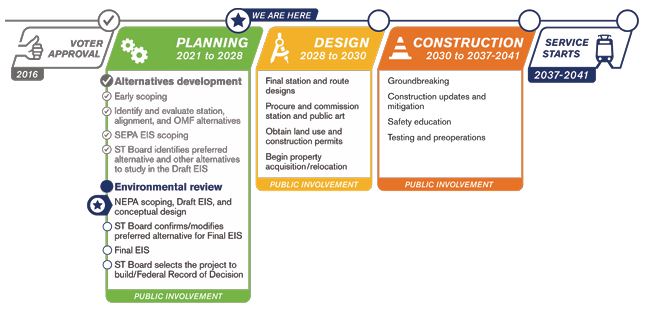
Key Project Milestones. Source: Sound Transit’s Draft EIS Executive Summary
Sound Transit estimates travel from Everett Station to Lynnwood City Center at about 33 minutes and to downtown Seattle at about 60 minutes. Phase 1 would run from Lynnwood City Center to the Southwest Everett Industrial Center in 2037 and Phase 2 would reach SR 526/Evergreen and Everett Station in 2041.
The project includes OMF North, which Sound Transit says is essential to store and service a larger fleet. The facility would need about 80 to 100 or more acres near the line and is planned to open before passenger service. Parking at the Mariner and Everett stations is currently deferred with no firm date.
Riders are expected to use buses and the existing park-and-rides at Everett, Ash Way and Mariner. Earlier 2026 project materials had parking opening around 2046 with about 550 spaces at Mariner and 1,000 at Everett Station but that 2046 target is no longer funded in the adopted plan.
The eight segments in the Draft EIS run generally parallel to Interstate 5, Airport Road, and State Route 526. West Alderwood, SW Everett Industrial Center, Broadway/I-5, and Everett Station already have Board-identified preferred alternatives (ALD-2D, SWI-1A, BI-1, and either EVT-2C or EVT-3D). The remaining segments—Ash Way, Mariner, SR 99/Airport Road, and SR 526/Evergreen—and all three OMF sites remain open.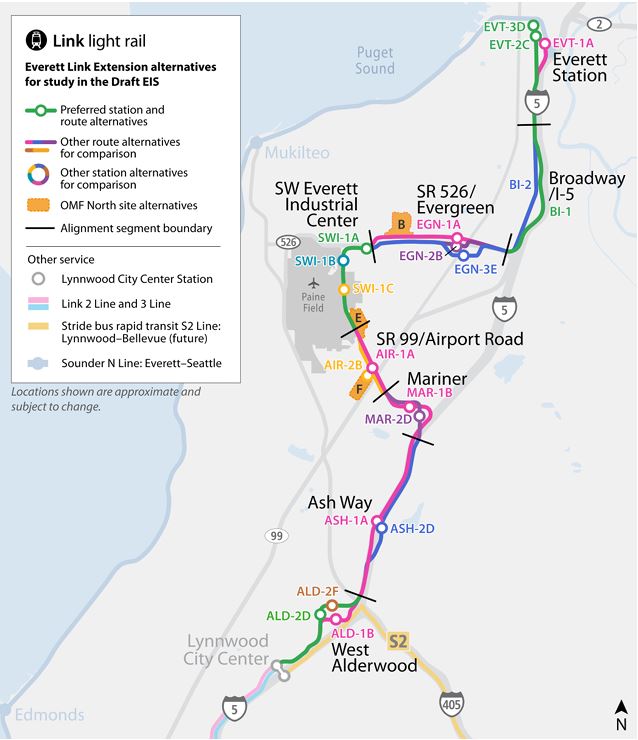
Project Alternatives. Source: Sound Transit’s Draft EIS Executive Summary
Alignment options are numbered and station options lettered, then combined into named alternatives such as ASH-1A or MAR-2D. Design options, including a lowered guideway, surface rather than structured parking, or a north-side alignment along SR 526, can be mixed with the base alternatives.
Comparison tables in the Draft EIS Executive Summary evaluate how these alternatives differ on displacements, land conversion, noise, ecosystems, and cost.
Mariner alternatives would displace 287–300 residences and dozens of businesses, including a library, grocery stores, and HUD-assisted apartments. Ash Way and Broadway/I-5 would each displace dozens of homes. OMF Site F would take 186–189 residences and affect 11 historic properties; Site B would displace fewer homes but would fill a stream that cannot be replaced on-site and would affect specialty manufacturing operations. Site E would disturb the largest wetland acreage (5.2 acres) and 850 linear feet of stream.
Noise and vibration numbers look high but according to the tables these drop to zero after mitigation action is taken.
Segment costs (2025 dollars) alone total from roughly $6.98 billion to $8.52 billion:
OMF sites range from $1.72 billion to $2.61 billion (2025 dollars) because each would occupy 50–70 acres of operating area (80–100 acres including construction and mitigation) and would include two-story maintenance buildings, storage tracks, and testing facilities needed for the expanding Link fleet.
Ridership forecasts also vary at about 900 daily boardings at the unfunded Airport Road station versus 10,700 at Everett Station. Ridership forecasts at West Alderwood 1,900, SW Everett Industrial Center 1,500, SR 526/Evergreen 2,900, and both Ash Way and Mariner about 4,600 each.
The Draft EIS also examined potential design refinements that could lower the overall Everett Link extension cost if adopted. These include the following:
A qualitative review found that some refinements could affect 31 additional properties: three in West Alderwood, 16 in Ash Way, six in SW Everett Industrial Center, and six in the Everett Station segment. At the same time, the same refinements would reduce the total number of properties that need to be acquired across the whole project and would spare one historic property in the SR 526/Evergreen segment that would otherwise be displaced. No refinements have yet been identified for OMF North.
Even with mitigation built into the designs, the project will require the removal of mature vegetation along the guideway and localized loss of upland habitat. The EIS Draft mentioned that there will also be temporary construction effects of lane or road closures lasting more than four months, noise, lost parking, and reduced visibility for adjacent businesses.
Several issues still remain unresolved and are flagged as areas of controversy in the EIS Draft. Funding has not been identified for the provisional SR 99/Airport Road station or for the Mariner and Everett parking facilities. The type of parking at Mariner (surface lot versus a garage) is still open. Also, agreements with the Washington State Department of Transportation for use of interstate right-of-way have not been completed.
One Everett Station alternative conflicts with a planned outdoor event center; and large wetland and stream impacts at OMF Sites E and B could create permitting, schedule, and budgetary risk.
Sound Transit conducted SEPA scoping in 2023 and NEPA scoping in 2025. The board will make its official decision on route, stations and the OMF North site after environmental review is complete with is expected in or around 2027.
Background on the May 2026 key vote
The comment period arrives four months after the Sound Transit Board voted to keep Everett Link fully funded. On May 28, the board adopted an updated Sound Transit 3 system plan through Resolution R2026-11, a 16-2 vote that Sound Transit described as a way to address a $34.5 billion funding gap while preserving the 2016 voter-approved program.
The total estimated remaining project cost to complete ST3 was projected at $149 billion by 2046 with a $34.5 billion cost avoidance need (up 25% since Fall 2024) no later than 2033 —approximately $30 billion of the cost overrun is attributed to capital cost growth. The West Seattle Link Extension ballooned from $4.2 billion in the finance plan to between $7 billion and $7.9 billion. The Ballard Link Extension climbed from roughly $11.9 billion to between $20.1 billion and $22.6 billion. Combined, the two lines exceeded $30 billion before adjustments—87% of the overall project cost overruns.
The 16-mile Everett Link Extension (Phases 1 & 2) has a 2026 estimated completion cost of now $12 billion, up from the $9.5 billion pitched in May 2026, and up from $7.7 billion in 2025 or $2.9 billion since its 2021 based estimate, which is far less than the $30 billion for the West Seattle and Ballard extension.
Author: Mario Lotmore