

EVERETT— Congressman Rick Larsen (WA-02) officially kicked off his campaign on Tuesday, June 16, at Bluewater Distilling on the Everett Waterfront, to retain his seat representing Washington’s Second Congressional District which encompasses portions of Snohomish, Island, San Juan, Skagit, and Whatcom counties. But prior to the event, Lynnwood Times Senior Reporter Kienan Briscoe sat down with Representative Larsen at Mukilteo’s iconic coffeehouse, Red Cup Café, in an exclusive interview to discuss legislative policies over the last two years and upcoming priorities.
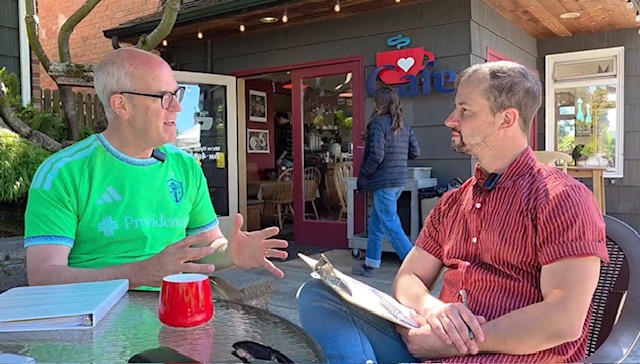
If elected to serve another term, Larsen said his priorities will be transportation infrastructure and safety, marine conservation, affordability and government accountability, expanding healthcare accessibility, and continuing to invest in major projects throughout Northwest Washington.
Larsen, who arrived dressed in a Seattle Sounders kit jersey in honor of his favorite local team, explained he came dressed in the spirit of both the Sounders and the FIFA World Cup — which commenced on June 11.
The Arlington native, and self-proclaimed “soccer nut,” reflected on a lifelong connection to the sport dating back to playing as a child, through his efforts in bringing FIFA World Cup matches to Seattle.



Larsen said he joined bipartisan congressional efforts supporting the United States’ joint World Cup bid with Canada and Mexico and later advocated for Seattle’s inclusion as a host city.
“I’m not claiming 100% credit,” Larsen joked, “but I’m in a position to help where I can.”


Beyond helping secure matches, Larsen said Congress has approved hundreds of millions of dollars to support tournament security and transportation operations.
The funding includes resources for law enforcement overtime, counter-drone technology and transit improvements.
“It’s really great,” Larsen said of the tournament atmosphere, adding that he believes the event will showcase the Pacific Northwest to visitors from around the globe. “People are literally coming from all over the world to the Northwest to enjoy themselves.”
Transportation, Safety and Workforce Development
Getting into more legislative topics, with Larsen co-sponsoring several key pieces of legislation in the last two years – including the FAA Reauthorization Act of 2024 (signed into law May 2024), and the more recent $580 billion BUILD America 250 Act (a bipartisan surface transportation reauthorization bill co-sponsored with Chairman Graves that overwhelmingly passed the House Transportation Committee in May of this Year) – he was asked what specific projects in the Second District he hopes to see advance with continued federal infrastructure investments.
Larsen, who serves as the top Democrat on the House Transportation and Infrastructure Committee, shared that federal investments in aviation, roads, rail and ports continue to drive economic growth across Northwest Washington.
“Transportation and infrastructure investment is critical in the Northwest for job creation. Infrastructure investment equals jobs. It’s a pretty simple formula,” Larsen said.
As for specific projects, Larsen pointed to federal aviation funding supporting improvements $82.1 million at regional airports including Paine Field, Bellingham International Airport and Skagit Regional Airport. According to Larsen, those investments improve runways and taxiways while making the region more attractive to private business investment.
“When you build that infrastructure, it makes it more attractive for folks to invest in businesses here in the Northwest,” Larsen said.
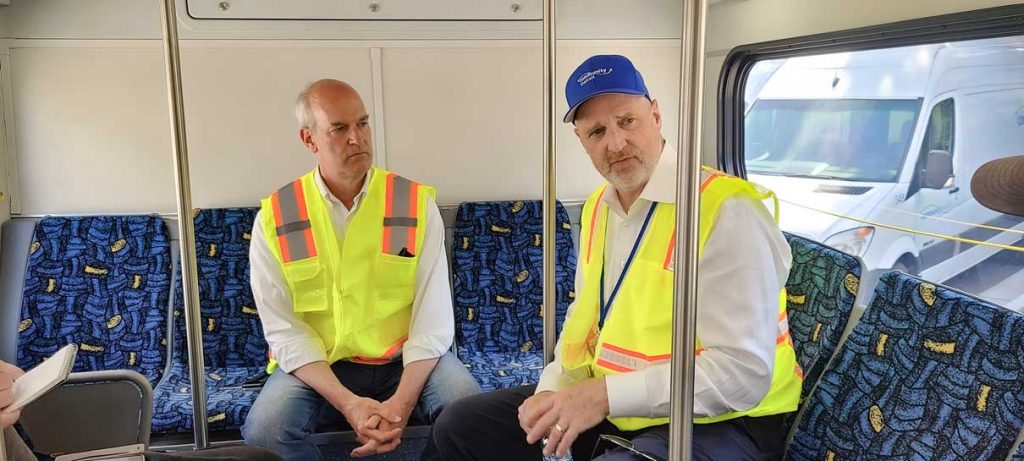
Larsen also highlighted provisions in the recently enacted FAA Reauthorization Act and the pending surface transportation reauthorization package, saying both measures emphasize safety, accessibility and workforce development.
The FAA Reauthorization Act is a major bipartisan law that funds the Federal Aviation Administration (FAA) and sets the rules for U.S. air travel. The latest five-year law provides $105 billion to improve airport safety, upgrade technology, and protect passengers.
Among the aviation priorities he championed are improvements for travelers with disabilities and investments in runway safety technology.
“Accessibility has been key. Safety has been key,” Larsen said, specifically citing efforts to improve training for airport personnel handling wheelchairs used by travelers with mobility impairments, including veterans. “These are not wheelchairs that you use at hospitals. These are wheelchairs that these people really depend upon to move around.”
The congressman also stressed investments in surface awareness technology at airports that help air traffic controllers monitor aircraft movement and reduce the risk of runway incursions.

On the ground transportation side, Larsen said roadway safety remains a major priority.
“We have 40,000 roadway deaths a year still in this country. And improving roadway safety, in part, is a matter of making those investments to separate cars and trucks from walkers and bikers, to improve intersections, to improve our freeways and our state roads as well,” Larsen said. “My basic principles on aviation and on road movement, surface transportation movement have been to get a safer, more reliable and more accessible and cleaner transportation system built.”
Federal funding, he continued, helps communities redesign intersections, separate vehicles from pedestrians and cyclists, and improve highways and local roads.
According to Larsen, these infrastructure investments also create opportunities to train the next generation of skilled trades workers benefiting overall workforce development.
“We’re building the next generation workforce — carpenters, laborers, bricklayers, cement masons — building that workforce while we’re building the infrastructure,” Larsen said.
A bottom-up approach to Marine Conservation
On June 3, Larsen’s Northwest Straits Marine Conservation Initiative Reauthorization Act passed the House with a strong bipartisan vote of 374 to 49.
The bill is designed to save and protect the northern waters of Puget Sound and the Strait of Juan de Fuca in Washington State. It formally reauthorizes a community-led environmental program for seven years, providing $10 million annually to fund local marine habitat restoration.
“The whole idea is to give local people the opportunity to develop marine conservation projects,” Larsen said, crediting former U.S. Rep. Jack Metcalf and U.S. Sen. Patty Murray with creating the original program in 1998.
Projects have included beach restoration in Howard Park, creosote piling removal in the Snohomish River Delta, forage fish habitat work and eelgrass restoration. Larsen said the legislation reflects a bottom-up volunteer-led conservation model rather than a federally directed approach.
The congressman acknowledged that convincing lawmakers from outside the Pacific Northwest can sometimes be challenging but said bipartisan relationships were instrumental in securing passage, specifically mentioning Rep. Bruce Westerman (AR-4).
Addressing the Fentanyl Crisis
Larsen believes he is in the best position of all the candidates running to continue his work fighting the nation’s fentanyl crises, and substance abuse-related issues in general.
The Washington State Narcotics Investigators Association (WSNIA) presented its 2024 Congressional Member of the Year Award to Rep. Larsen for supporting the efforts of Washington’s 16 multi-jurisdictional drug task forces (MJTFs) in combating the opioid and fentanyl crisis.
Larsen was able to secure $2.7 million toward drug task force funding from the Washington State Legislature in 2024 in addition to his efforts on federal investment to combat the opioid and fentanyl crisis, including in Byrne JAG funding that supports Washington’s 16 active MJTFs.
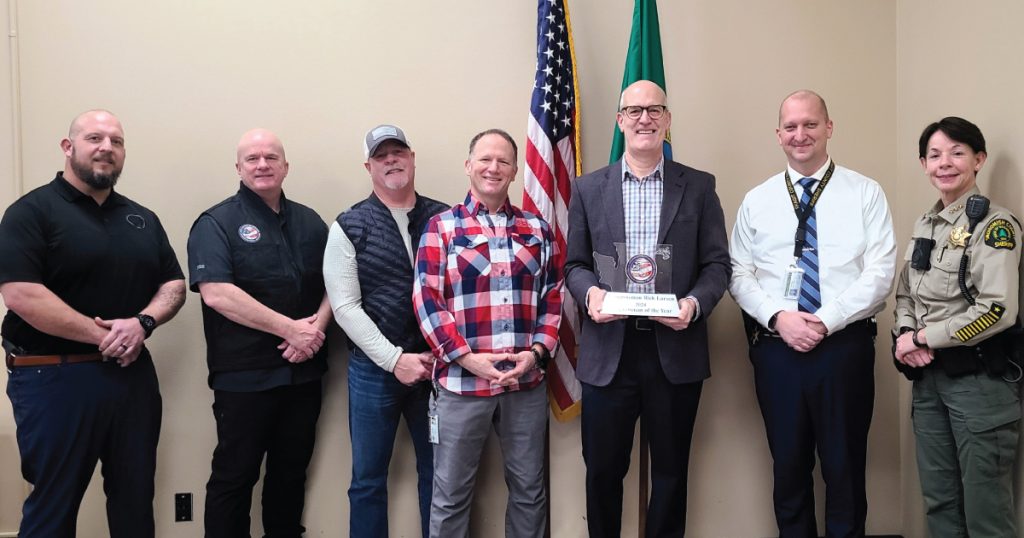
Larsen and his staff, also in January 2024, released an opioid report that analyzed the opioid epidemic in Northwest Washington while presenting several federal policy recommendations they believe could address the issues facing local communities—prevention, interdiction, treatment and recovery.
The fentanyl epidemic specifically, Larsen said, is one of the region’s most pressing public safety challenges to which he outlined a package of legislation aimed at reducing the flow of illegal narcotics while expanding treatment options.
“One is to support our local drug task forces with dollars so they have operational dollars to continue to do the literal gritty undercover work that they’re doing,” Larsen said.
The congressman also highlighted concerns raised by tribal leaders about traffickers using reservation lands to move narcotics, calling reservations the “backdoors for cartels to bring drugs in” to the community.
To support local efforts to combat the drug crisis plaguing families, Larsen introduced the bipartisan PROTECT Act to give Tribal courts and law enforcement more tools and resources to combat the opioid epidemic, the Closing the Substance Use Care Gap Act of 2024 to award grants to support community-based programs for harm reduction services, and the End Fentanyl Trafficking with Local Task Forces Act of 2024 establishing grants to combat opioid trafficking.
The PROTECT Act—Protection for Reservation Occupants against Trafficking and Evasive Communications – if passed, will give Tribal courts and law enforcement the ability to prosecute drug-related crimes for the first time in nearly half a century.
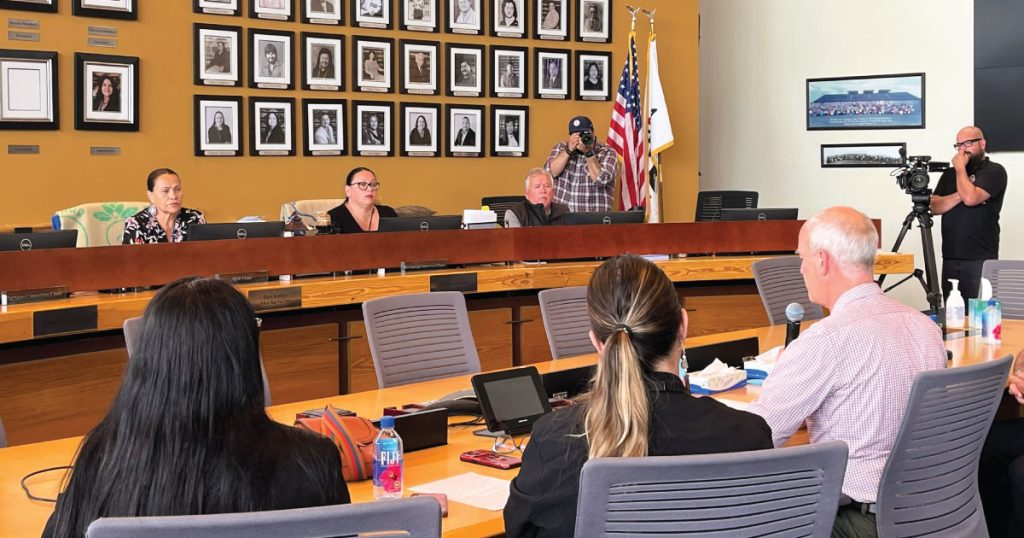
Since the landmark 1978 Supreme Court ruling, Oliphant v. Suquamish Indian Tribe, tribal courts have been unable to prosecute non-American Indians for most crimes including drug trafficking. In a time when opioid-related deaths are at an all-time-high, this has rendered many tribes helpless to combat the wave of organized crime that has taken advantage of, what Tulalip Tribal leaders consider, a broken law “very much steeped in racism.”
However, Larsen stressed that enforcement alone cannot solve the crisis.
“It’s not just a law enforcement issue,” Larsen said. “It is that. And it’s also treatment and recovery and education.”
He added that even if fentanyl eventually becomes less prevalent, lawmakers must remain vigilant.
“If fentanyl ever goes away or becomes less of a problem, I assure you there will be a different drug that takes its place,” Larsen said.
Rural Healthcare and Hospital Access
Healthcare access in rural communities remains another legislative priority for Rep. Larsen, who is currently working with Washington Republican Rep. Dan Newhouse (WA-04) on legislation designed to help financially struggling hospitals serving tribal and military populations qualify for enhanced federal support.
The measure would grant certain facilities critical-access hospital status, providing additional reimbursement and helping prevent closures.
“This legislation would help areas with a large rural or tribal population so these hospitals aren’t in danger of shutting down,” Larsen said, describing the goal of the legislation.
He also voiced support for continued funding of community health centers throughout the district, including clinics serving rural and underserved populations.
“Rural healthcare access is incredibly important to me. That’s why I’m supporting also increasing funding for our community health center networks. We have them here in Snohomish County, Community Health Center of Snohomish County, it’s called. But we also have Seamar, which started off largely serving a Hispanic population. And they’re both in urban, suburban, and rural areas in the district. And so supporting continued funding for our community health center network as well, it helps to increase access,” said Larsen.
Affordability and Accountability Tops Election Concerns
Looking toward the upcoming election cycle, Larsen said affordability and government accountability are dominating voter concerns and his top priorities.
“The president promised lower prices and no wars, and we have higher prices and more wars. Gas prices have increase by about 55% since the start of the Iran conflict. And those aren’t coming down anytime soon – gas prices increase quickly and come down slowly,” said Larsen. “Tariffs are also keeping grocery prices high here in the Pacific Northwest. Our proximity to our friends in Canada also means that Canadians aren’t coming into Whatcom and Skagit or Snohomish County as often as they were to spend their money. They’re spending it in Canada, and that’s impacting the livelihoods in the Pacific Northwest.”
Regarding accountability, Larsen pointed to President Donald J Trump’s new White House ballroom, which he promised would cost $200 million with no taxpayer money. Now, he said, that cost is projected to be $600 million, half of which is expected to come from taxpayers.
“Either he lied or he was ignorant. It doesn’t matter what the fact is that public tax dollars are being paid to build something that no one wants but him,” said Larsen.
According to contractor documents reviewed by the Washington Post, the Office of Management and Budget (OMB) redirected $352 million in funds originally intended (in part) for Secret Service training and recruitment to “White House Security Measures” — an account tied to the project’s security features.
Federal Investments Across Snohomish County
Asked about recent accomplishments, Larsen highlighted several federally supported projects in Snohomish County.
Among them was the newly completed Edgewater Creek Bridge project in Mukilteo, which received approximately $850,000 in congressionally directed funding.
He also pointed to an $11 million grant awarded to the Port of Everett for redevelopment of Pier 3 and a $2 million federal earmark for the Latino Educational Training Institute in Lynnwood. According to Larsen, the LETI funding will help expand educational and workforce development opportunities for the region’s Latino community.
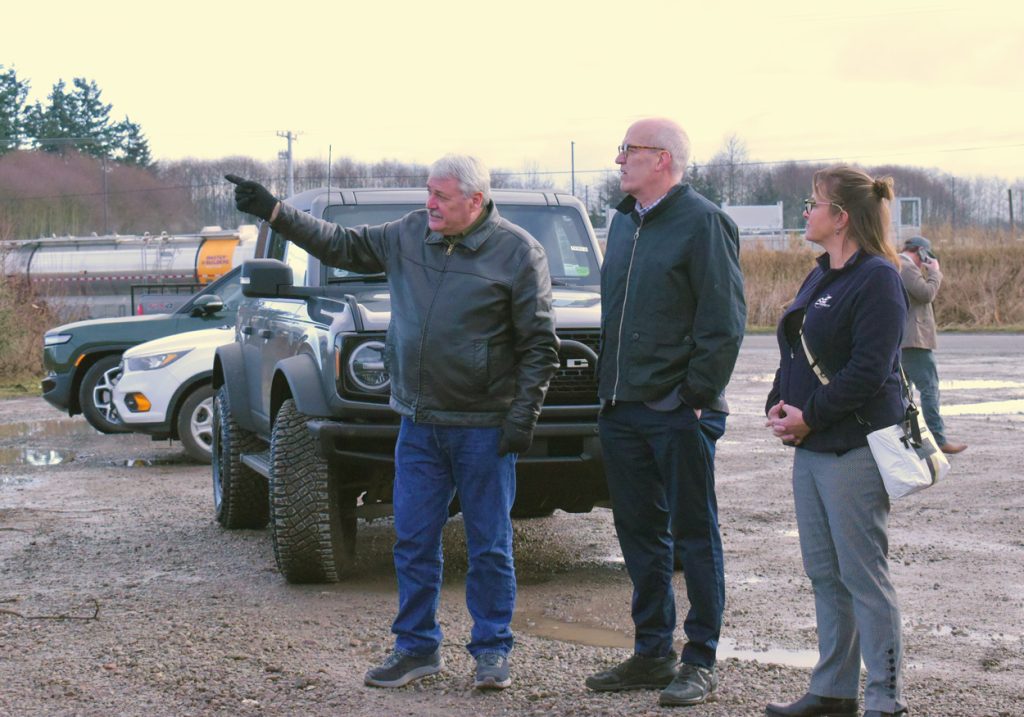
Additional investments include transportation and rail projects in Everett intended to improve freight mobility and support industrial redevelopment.
“All these are really focused on supporting the transportation network and helping to maintain our competitiveness,” Larsen said.
In addition to these, Larsen was pivotal in securing $1.2 million for the Edmonds Waterfront seawall, and $3 million for the Lynnwood Neighborhood Center – a brand-new community gathering place and resource hub.
Supporting Boeing and Naval Station Everett
Larsen also discussed efforts to support two of the district’s largest economic drivers: Boeing and Naval Station Everett.
He said he continues to advocate for future Navy frigates to be homeported in Everett and recently backed a 3.8% pay raise for service members.
A big part of Larsen’s platform has revolved around supporting the country’s veterans. He wants to continue working with veterans suffering from homelessness, expanding their access to healthcare, and ensuring that there is a VA nearby they can visit.
Regarding Boeing, Larsen emphasized the importance of supporting the aerospace workforce rather than focusing solely on the corporation itself.
“I represent more Boeing employees than anybody in Congress,” Larsen said, noting that Boeing’s workforce drives economic activity throughout communities including Everett, Arlington and Stanwood.
Larsen also stressed the importance of maintaining a robust Federal Aviation Administration capable of certifying aircraft and components safely.
“I want these flights to be the least exciting thing that happens to people on their travel day,” Larsen said.
Larsen’s Campaign kickoff
Following the Lynnwood Times’ interview with Larsen, he officially kicked off his campaign at the Port of Everett’s Bluewater Distilling company where he mingled with constituents and enjoy hors d’oeuvres and cocktails.
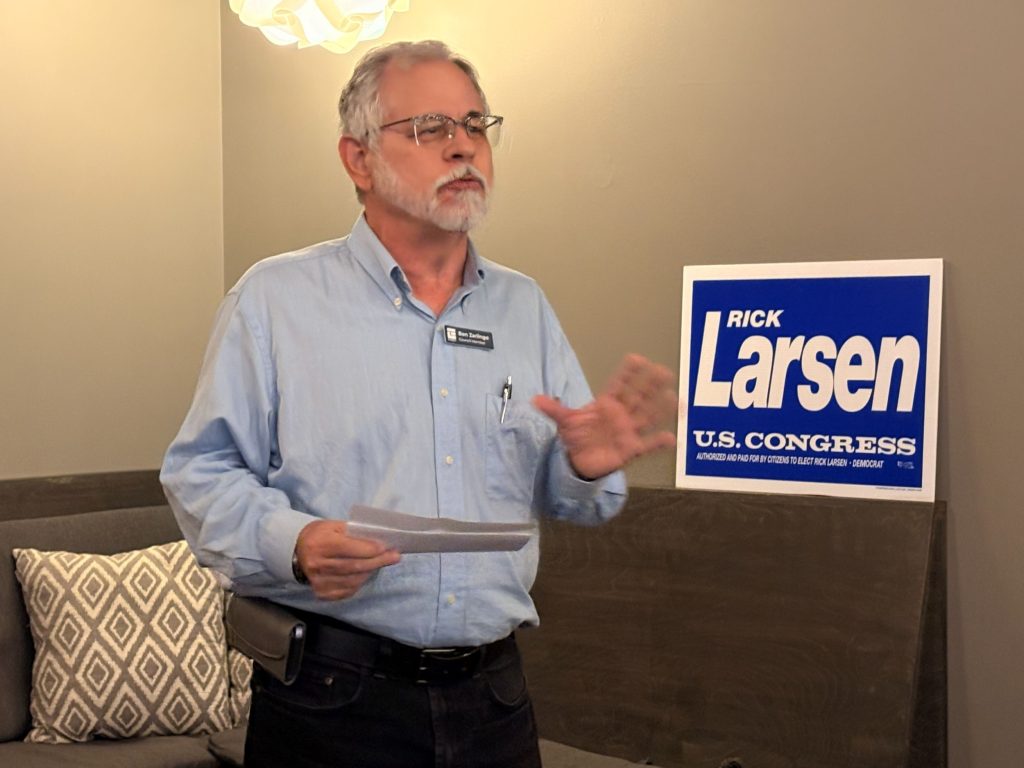
Among the attendees was Everett City Council member Ben Zarlingo, who endorsed Larsen’s campaign and joked that Larsen is “always everywhere,” which is a big sign for someone who’s commute is a six-hour flight from Washington D.C.
“Rick Larsen is a really effective representative for district two here in Northwest Washington and for the rest of the state as well. He has a deep record of practical positions and is a potent advocate every time we need one at the federal level. He also manages to stay well connected and available for all of us working at the city and county level,” Zarlingo told the Lynnwood Times.
Full 40-minute Interview with Congressman Rick Larsen
Author: Kienan Briscoe