

LYNNWOOD— Speaking at Monday’s City Council meeting, Lynnwood Mayor George Hurst warned that the city can no longer rely on its General Fund reserves to balance the budget, saying his administration is committed to balancing the books through spending reductions and adherence to the city’s financial policies.
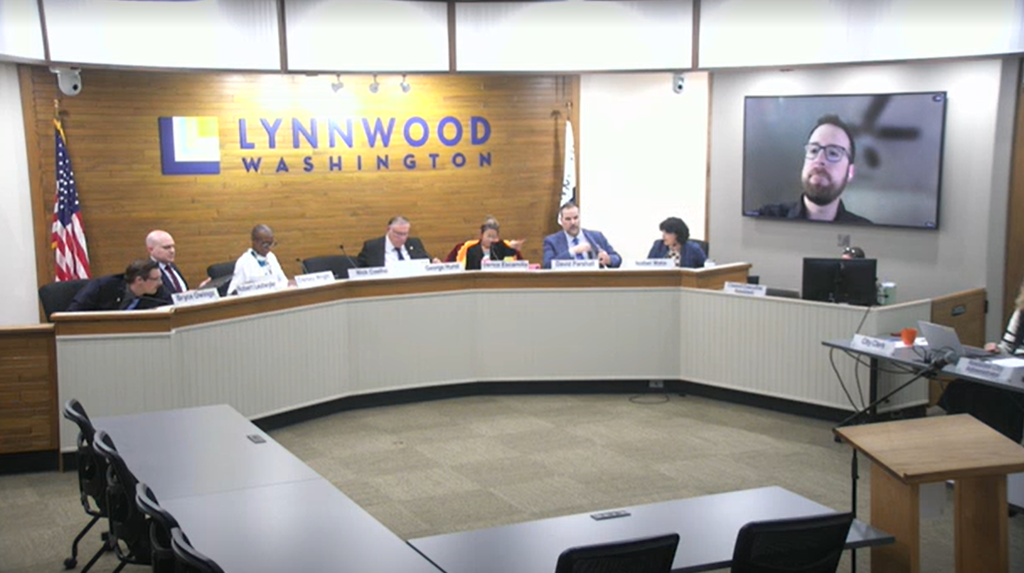
Mayor Hurst began his discussion on the budget with an allegory, telling the story about the “Balloon Ladies” at Disney Land’s 10K races.

Balloon Ladies, Hurst explained, essentially set the pace of the race. If they catch up to you you’re swept off the track and put in the “bus of shame,” and driven back to the start area without finishing.
“The term Balloon Ladies, to me, indicates that you don’t want these people to pass you…We thought back in March that we fixed the deficit of 2026 but then when the former Finance Director left and finished up 2025, we found out that 2025 wasn’t even balanced. It was two-and-a-half million off. That was a balloon lady coming closer,” said Hurst. “The point I’m making with this allegory is there are a lot of warning signs that the city is facing this year, and I don’t want this city to be metaphorically swept off the track.”



Hurst noted that Lynnwood has a history of spending more than money comes in. However, seeing as the city is largely dependent on sales tax if things are going badly the revenue generated from the sales tax typically can bridge those divides.

In the first quarter of 2026, Lynnwood generated roughly $16.5 million in sales tax but its expenses were $17.6 million.

Back in 2016 the, then, Lynnwood Finance Director Springer warned the council that if the city kept drawing from the General Fund to balance the budget she predicted it would “hit bottom” by 2022. Luckily the city has had the cushion of sales tax to hit zero so that didn’t happen. Still, the General Fund kept declining
However, this year the city does not have the General Fund balance to balance the budget and still adhere to the City’s Financial policies.
“This budget is my budget. I don’t care what happened in previous years with previous Mayors. My budget is going to be balanced. And we’re not going to balance it by drawing more funds from the General Fund balance. We’re going to balance it by how the financial policies are written,” said Hurst.
These financial policies include: the General Policies section of the LMC (subsection 2.A) which states “it is the City’s intent to maintain fiscal integrity while providing a level of public goods and services that is within the city’s fiscal capacity,” the Expenditures: General chapter (subsection 10.A), which states “The City shall authorize only those ongoing, operating expenditures that may be supported by ongoing operating revenues,” and the Contingency Planning and Responding to Revenue Downturns chapter (subsection 11.B.III) which reads “Rather than instituting ‘across the board’ reductions, specific performances measurements criteria should be utilized to reduce/discontinue certain levels of service, or delay/discontinue certain projects.”

Adhering to these policies, some difficult decisions have been made by Mayor Hurst and his team. 14 staff members have since been laid off, 8 vacant positions were eliminated, and 7.5 vacant positions have been held vacant throughout the budget process – in the DBS, Executive, Finance, Human Resources, IT, Parks and Rec, Police, and Public Works departments.
With the passage of the 0.1% Public Safety Sales Tax, increase of the Utility Tax from 6% to 10%, and recent approval of cannabis retail stores, this has raised annual revenue for the city by $3.5 million…but it’s still not enough to reach zero even with the layoffs.
The reality is 2025 ended in a deficit of $2.2 million more than anticipated, Hurst said Monday, and the 2026 gap appears to be widening as revenues fall further behind.
Project inflation is above 4%, the Iran war resulted in increased gas prices and lower spending, the sales tax revenue was under projected by $2 million (43% of budgeted, not 50%), insurance costs have skyrocketed, medical costs for the Jail may double resulting in an additional $1 million per year, and the previous budget was built on revenues reflecting bumps and not averages.
As the city moves forward with its proposed budget, staff are making a lot of assumptions. For one, the city assumes it will approve a Property Tax of $11,104,548 (which includes all banked capacity for the Lynnwood Property Tax). This will result in the average household seeing an increase of $128 in 2027 or $10.70 per month in property taxes.
The good news for residents, however, is at the request of Public Works staff, the scheduled City Utility Rate increase for 2027 was repealed by the City Council back in September.
In the wake of controversies associated with expanding revenue from speed and traffic enforcement cameras, Hurst said the council will be presented with an upcoming ordinance soon that would reevaluate the system, limiting any additional TEC (Traffic Enforcement Cameras) revenue to be used for costs associated with administration and operations of the program. This additional revenue, Hurst continued, could potentially close the gap in the Public Works requests to increase General Fund contributions from $1.1 Million to $1.6 Million, which the 2027-28 budget does not currently include.
Hurst is also proposing the city revise Fund 116, which is the Cumulative Reserve Art Fund, to include the salary of the Arts, Cultural and Heritage Coordinator. This would not be a request for a new fee or tax, it would take advantage of an underutilized fund while preserving an “important staff position.”
The revenue sources, on the other hand, would remain the same (1% of the budget for certain municipal construction projects).
Following a comment by Councilwoman Isabel Mata in which she stated she wanted to ensure cuts don’t impact essential services, Council President Nick Coelho asked the mayor what drove the decision on which staff positions to cut, and which to preserve.
Hurst said the decisions were driven by the city’s financial policy ultimately but deferred to Interim Finance Director Monisha Harrell.
Harrell noted that, in addition to the city’s financial policy being used as a guide, some of the city’s decisions were driven by legal requirement. The Jail, for example, must have a certain number of staff to remain operational by statute.
“I like to say that 2027-28 is the smallest Lynnwood will ever be again because the intention is we use the next biennium to find what our value system is and what our strategic pathway forward for sustainable growth,” said Harrell. “Annexation will be part of those conversations. We would double our population if we annexed the entire area that is available to us. We’re not going to build another City Hall, we’re not going to duplicate our services, but we would add a couple of staffers to be able to service those communities, so the overhead costs are actually absorbed by a larger body to help Lynnwood be more affordable. Every one of these departments will grow, but we need the blueprint so we don’t find ourselves back in this situation.”
Moving forward in the budget process Council President Coelho suggested council members split off into pods, and Mayor Hurst said he will be providing budget books as a resource.
Mata calls upon Lynnwood to reject citizens’ initiatives
Councilwoman Mata called upon the Lynnwood City Council, and Lynnwood residents, to reject Washington State Initiatives IL-26-638 (which requires students participating in sports to provide their sex assigned at birth, confirmed by a medical professional) and IL-26-001 (concerns parental rights of children at public schools) at the November 3 General Elections.
She asked the council to bring forward a resolution that states the collective opposition of these initiatives for its meeting on November 26.
Interim Paid Parking Ordinance Extension
The Lynnwood City Council also voted to approve an extension of a paid parking ordinance, the current of which expires this December, for an additional six months.
Councilwoman Isabel Mata, the lone no vote, said she did not support the ordinance stating she didn’t believe it aligned with the city’s values.
“When we first voted on this topic, I think this was a great idea. It was a temporary fix for an issue we were having with the transit center and having people coming into Lynnwood, and even residents of Lynnwood, being able to park without getting their cars towed,” said Councilwoman Mata. “But I worry if we extend it we’ll keep extending it and I don’t think it solves the actual problems, which is making it easier, and safer, for Lynnwod residents to get to the light rail so that they don’t have to have parking.”
Despite Mata’s opposition, Council member Robert Leutwyler moved to approve the motion seconded by David Parshall. While he understood a lot of the concern – stating it doesn’t necessary solve the transit parking situation — he said it does continue to help the situation for the next six months at which the city can always revisit it.
Council Vice President Derica Escamilla echoed Leutwyler’s comments adding that Lynnwood can have faith that the city will not be making this a full-time solution, nor will they turn the city into a parking garage.
Council President Nick Coelho added that he would like to see how the parking situation at least does after the city introduces a farmer’s market close to the transit center, adding that he will likely vote no next time but yes this time.

Author: Kienan Briscoe